Claude Fable 5 vs Opus 4.8 for Coding: Which Model Should You Actually Use
 By Neo Zino - builder of ClockedCode9 min read
Claude Fable 5 vs Opus 4.8 for coding: real pricing, specs, and the actual documented reason Claude Code switches you to Opus 4.8 mid-session.
Made with DispatchSEO
On this page
Start with Claude Opus 4.8 for coding. That's not my opinion - it's Anthropic's own "Choosing a model" guidance, and it holds up: Opus 4.8 costs half as much per token as Claude Fable 5, has no safety classifiers that can reroute a request mid-session, and is already the default on most account types. Reach for Fable 5 specifically when a task needs the highest available capability - long, ambiguous, multi-step work - and budget for the fact that its classifiers will occasionally hand your session to Opus 4.8 anyway.
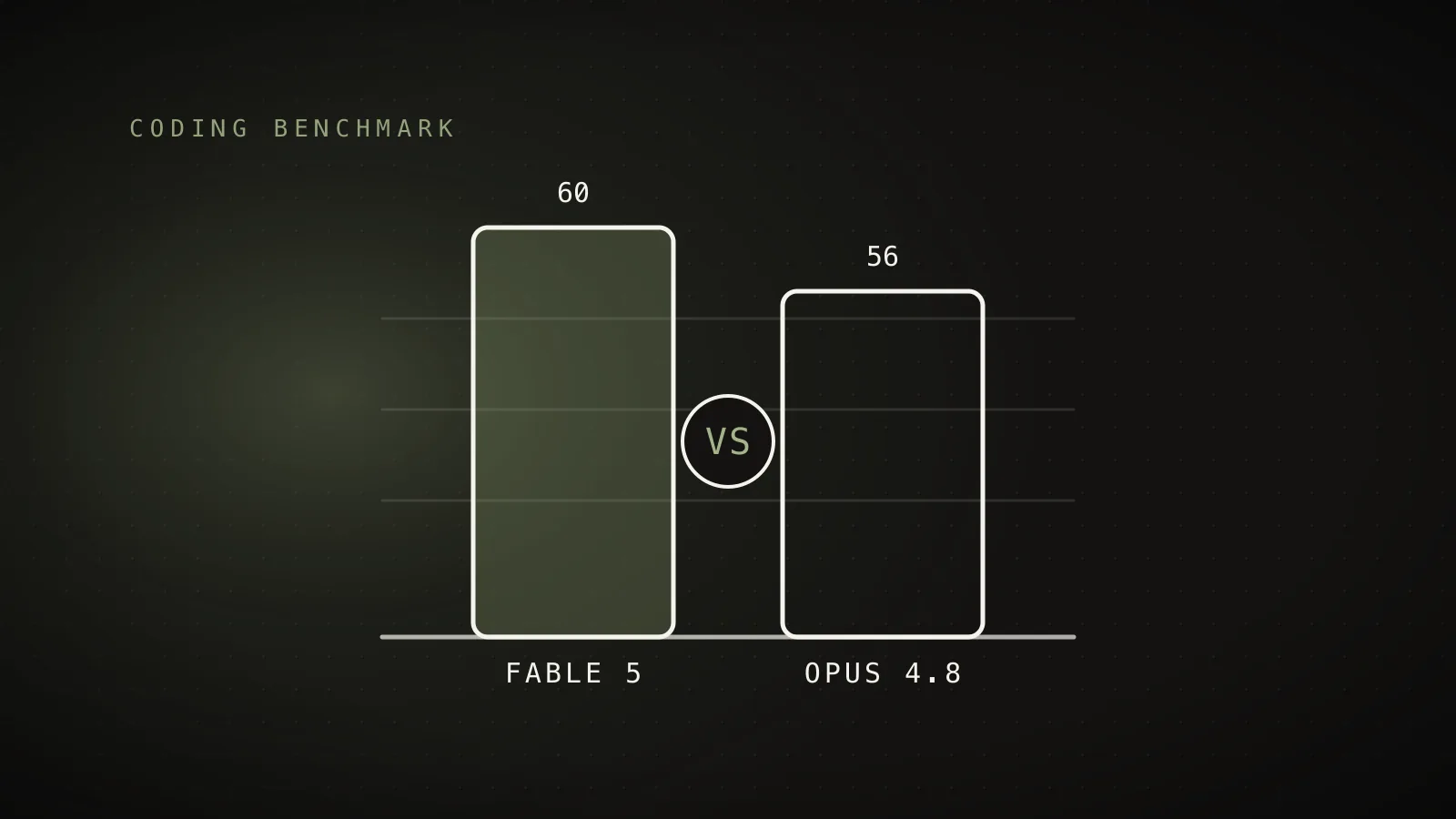
TL;DR: Fable 5 leads the Artificial Analysis Intelligence Index (60 vs Opus 4.8's 56) but costs twice as much per token and runs safety classifiers that Opus 4.8 doesn't have. When one of those classifiers flags a request - most often anything touching cybersecurity or biology, including your CLAUDE.md and git status on the first message of a session - Claude Code automatically re-runs it on Opus 4.8 and keeps the session there until you switch back with
/model fable. That's the real, documented mechanic behind the "Fable 5 defaults to Opus 4.8" reports circulating right now. It's a real feature, not a bug, and not literally silent, but it is easy to miss.
Claude Fable 5 vs Opus 4.8: the specs, price, and official guidance
AA Intelligence Index
Artificial Analysis, higher wins
Fable 5 wins this row
Price per 1M tokens
input / output
Opus 4.8 wins this row
Opus 4.8 is half the price on both input and output tokens.
Context window
tokens, per Anthropic's models overview
Same nominal cap, but Fable 5 uses the tokenizer introduced with Opus 4.7: the same text produces roughly 30% more tokens than on Opus 4.8, so the working room isn't actually equal.
Max output
tokens per request
Comparative latency
Anthropic's own label
Opus 4.8 wins this row
Read from Anthropic's models overview and Artificial Analysis on July 17, 2026. Anthropic publishes no head-to-head coding benchmark for these two models specifically.
Two things in that table matter more than the headline Intelligence Index score. First, the price gap is exactly double on both input and output tokens, and it's wider in practice than the sticker suggests: Fable 5 uses the tokenizer introduced with Opus 4.7, and per Anthropic's own tooltip on the models overview page, "the same text produces roughly 30% more tokens" than it would on Opus 4.8. A 1-million-token context window isn't the same amount of actual room on both models. Second, Anthropic's own model-selection page doesn't hedge: "If you're unsure which model to use, start with Claude Opus 4.8 for complex agentic coding and enterprise work. For workloads that need the highest available capability, use Claude Fable 5." That's the vendor putting its cheaper, classifier-free model first for exactly the kind of work most Claude Code users do.
Why does Claude Code switch from Fable 5 to Opus 4.8 automatically?
What "Fable 5 falls back to Opus 4.8" actually is
Automatic model fallback, as documented for Claude Code
Fable 5's safety classifiers check every request
Scoped to cybersecurity and biology content - including your CLAUDE.md, git status, and directory names on the very first request of a session
A request gets flagged
Benign work can trigger it too - security tooling, auth/crypto code, and biology-adjacent repos are the common false-positive zone
Claude Code re-runs it on your provider's default Opus model
Opus 4.8 on the Anthropic API, LLM gateways, and Claude Platform on AWS - and writes a notice into the transcript
The session stays on Opus until you switch back
Run /model fable to return - or turn off auto-switch entirely in /config
Read from code.claude.com's model-configuration docs, section "Automatic model fallback."
This is the part the Reddit threads and rushed blog posts get partly right and partly wrong. Right: Fable 5 does hand coding sessions to Opus 4.8, and it can feel completely unpredictable. Wrong: it's not a launch bug, and it's not literally silent. It's a documented Claude Code feature called automatic model fallback, and it exists because Fable 5 - unlike Opus 4.8 - ships with safety classifiers for cybersecurity and biology content. Anthropic's own docs are direct about the false-positive rate: "benign cybersecurity work can also trigger this category," and offensive-security workloads - penetration testing, CTF exercises, biology-adjacent codebases - trigger it "frequently, often on the first request." For substantive biology work, Anthropic says to "expect nearly all requests to reroute."
The part most people miss: the trigger isn't limited to what you type. Claude Code's docs note that fallback "can trigger on the first request of a session, before you send anything unusual, because the first request carries workspace context such as your CLAUDE.md content and git status." A repo with security tooling, exploit code, or lab-adjacent material in it can trip the classifier before you've asked a single question. If you want to isolate whether your own setup is the cause, claude --safe-mode disables CLAUDE.md, skills, MCP servers, and hooks for one session - though git status and directory names still get included, since those aren't customizations.
Which model should you actually use for coding?
Answer these about the task in front of you
Routine work - a precisely described edit, a mechanical change, or a question about code already in context?
A subtle bug, an unfamiliar domain, or an architecture call that needs long, multi-step reasoning?
Does the work touch security tooling, exploits, auth/crypto internals, or biology-adjacent code?
Anthropic's own guidance points the same way: start with Opus 4.8 for complex agentic coding, and reach for Fable 5 only when a task needs the highest available capability.
None of these are close calls once you know your own workload. The one pattern worth planning around in advance: if your coding work lives anywhere near offensive security or biology, don't be surprised when Fable 5 barely stays Fable 5 for you - that's expected routing for those domains, not an account-level flag, per Anthropic's own docs. In that case, either work primarily on Opus 4.8 (you lose little - it's the vendor's own recommended coding default) or ask your Anthropic account team about trusted access for Fable-class capability on that kind of work.
How do you control automatic fallback in Claude Code?
The default behavior switches you over without asking. To get a choice instead, run /config and turn off "switch models when a message is flagged." After that, a flagged request pauses the session with two options: switch to the Opus model, or edit the prompt and retry on Fable 5. A few edge cases worth knowing:
- Non-interactive mode and SDK integrations can't show that prompt, so a flagged request there just ends the turn with a refusal - there's no silent reroute to fall back on.
- If both models flag the same request, your options are to edit the prompt or start a new session; there's no third model to fall back to in Claude Code itself.
- On Bedrock, Google Cloud's Agent Platform, and Microsoft Foundry, automatic fallback only works if Claude Code can identify both models from your configuration - set
ANTHROPIC_DEFAULT_FABLE_MODELandANTHROPIC_DEFAULT_OPUS_MODELto enable it there. - To go back to Fable 5 at any point after a fallback, run
/model fable.
Honest limits of this comparison
Anthropic has not published a head-to-head coding benchmark (SWE-Bench, Terminal-Bench, or similar) for Fable 5 against Opus 4.8 specifically - the numbers above are Artificial Analysis's independent index, not a vendor-run comparison the way GPT-5.6 Sol's benchmarks against Fable 5 are. Worth noting: Artificial Analysis tests Fable 5's public score with Opus 4.8 fallback already factored in - the model's listing on their site is literally labeled "Fable 5 (Adaptive Reasoning, Max Effort, Opus 4.8 Fallback)" - so even the independent benchmark treats the two models as a pair, not as cleanly separable alternatives. There's also Claude Mythos 5, which shares Fable 5's specs and pricing without the safety classifiers, but it's invitation-only through Anthropic's Project Glasswing and isn't a self-serve option for most readers. And this is a snapshot: fallback behavior, pricing, and the classifier categories are all things Anthropic can and does revise between releases, so re-check /docs/en/build-with-claude/refusals-and-fallback before you build a workflow that depends on the specifics here.
FAQ
Which is better for coding, Claude Fable 5 or Claude Opus 4.8?
Anthropic's own guidance says start with Opus 4.8 for complex agentic coding and enterprise work, and reach for Fable 5 only when a task needs the highest available capability. Fable 5 leads the Artificial Analysis Intelligence Index (60 vs Opus 4.8's 56) but costs twice as much per token ($10/$50 vs $5/$25 per million) and its safety classifiers can reroute coding work mid-session.
Why did Claude Code switch me from Fable 5 to Opus 4.8 mid-session?
Fable 5 runs safety classifiers for cybersecurity and biology content. When one flags your request, Claude Code automatically re-runs it on your provider's default Opus model (Opus 4.8 on the Anthropic API, LLM gateways, and Claude Platform on AWS) and writes a notice into the transcript. This can trigger on the very first request of a session, purely from workspace context like your CLAUDE.md or git status.
Is Fable 5's fallback to Opus 4.8 silent?
Not technically - Claude Code writes a notice into the session transcript every time it happens. It earned the "silent" reputation because that notice is one line in a long agentic run, easy to scroll past, and because /status doesn't surface whether a fallback chain is even configured.
How do I stop Claude Code from automatically switching models?
Run /config and turn off "switch models when a message is flagged." A flagged request then pauses the session so you can choose: switch to the Opus model, or edit the prompt and retry on Fable 5. To check whether your own CLAUDE.md or skills are the trigger, start a session with claude --safe-mode, which disables customizations but still includes git status and directory names.
Is Claude Fable 5 more expensive than Opus 4.8?
Yes, exactly double on paper: $10 per million input tokens and $50 per million output tokens versus Opus 4.8's $5 and $25. The real gap is bigger in practice, because Fable 5's tokenizer produces roughly 30% more tokens than Opus 4.8's for the same text, so a like-for-like task costs more than the sticker price implies.
Which model does Claude Code use by default?
Fable 5 is never the default. Max, Team Premium, Enterprise pay-as-you-go, and Anthropic API accounts default to Opus 4.8, as do Claude Platform on AWS, Amazon Bedrock, and Google Cloud's Agent Platform. Pro and Team Standard seats default to Sonnet 5. You only get Fable 5 by choosing it yourself with /model fable.
This score gap will close. The classifier won't go away.
Every few months one of Anthropic's own models leapfrogs another, the same way GPT-5.6 Sol and Grok 4.5 reshuffled the field around Fable 5 within a month of each other. Re-pull the models overview page before you commit a workflow to either number in the table above; a benchmark snapshot from today is not a promise about next quarter. What's more durable is the classifier itself: it shipped with Fable 5 specifically, and no future score bump removes it. If your repo touches security tooling or anything biology-adjacent, that's worth knowing before you standardize a team on Fable 5, not after the third unexplained model switch mid-sprint.
Your CLAUDE.md is one of the things Claude Code scans on that very first flagged request, which is as good a reason as any to know exactly what's in it. That's the whole premise behind the CLAUDE.md ClockedCode generates: know what your setup is telling the model before the model decides for you.