GPT-5.6 Sol vs Fable 5 vs Grok 4.5: Which Coding Model Should You Actually Use
 By Neo Zino - builder of ClockedCode8 min read
GPT-5.6 Sol, Claude Fable 5, and Grok 4.5 compared on live Artificial Analysis scores, pricing, context window, and which coding agent actually fits your work.
Made with DispatchSEO
On this page
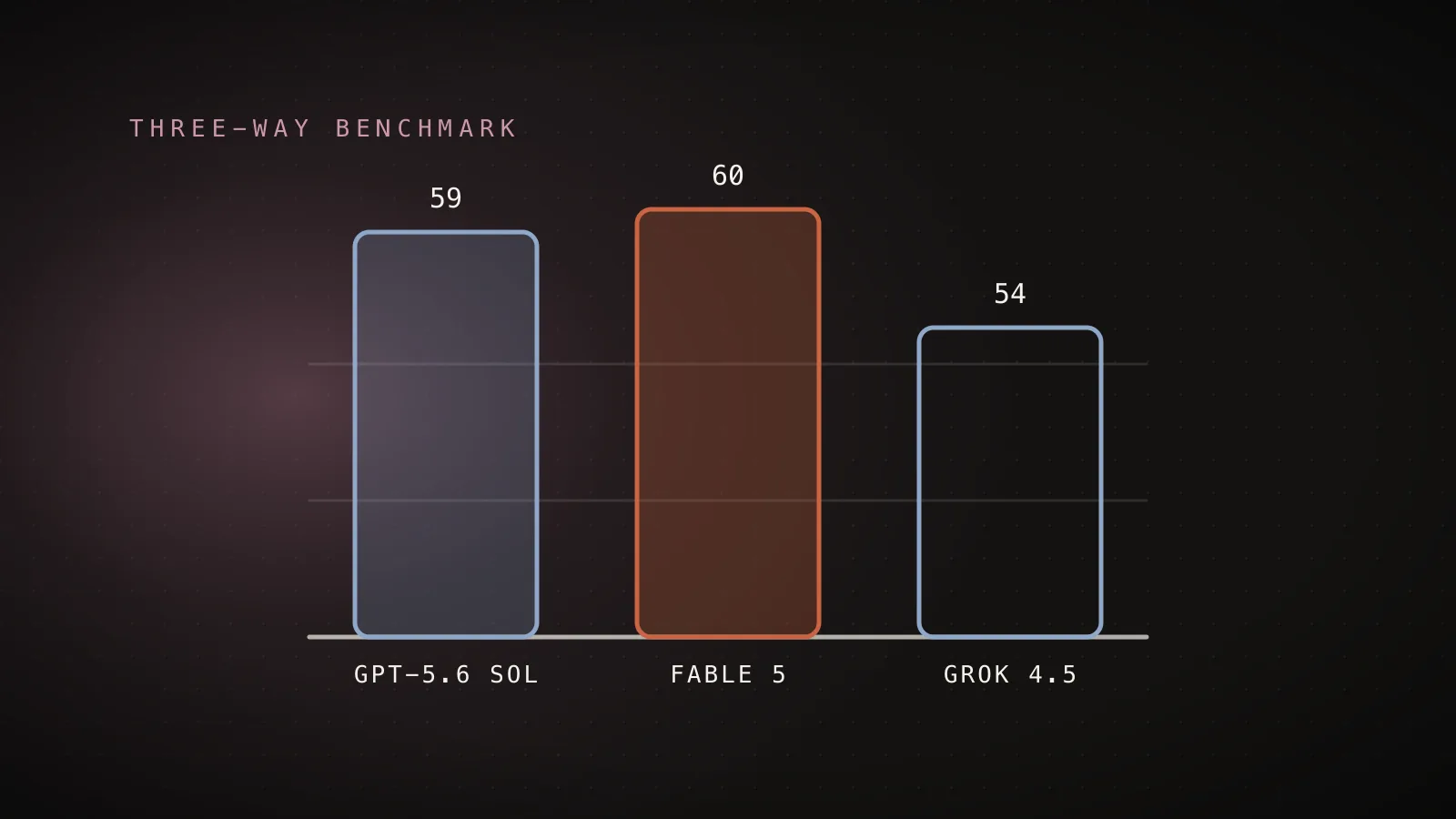
Pull up the Artificial Analysis leaderboard right now and three coding flagships sit within six points of each other: Claude Fable 5 at 60, GPT-5.6 Sol at 59, Grok 4.5 at 54, out of 188 models ranked. Nearly every video and Reddit thread comparing these three is still running launch-week screenshots, and the ranking has already shifted since then. I checked xAI's, Anthropic's, and OpenAI's own docs plus Artificial Analysis directly on July 16, 2026, and none of the three comes out flatly ahead. Each wins on a different axis, so the model of the three worth paying for depends entirely on what kind of coding work you actually do.
TL;DR: Claude Fable 5 leads the Artificial Analysis Intelligence Index (60) and code correctness. GPT-5.6 Sol leads agentic terminal-loop benchmarks. Grok 4.5 is the cheapest of the three by a wide margin ($6 per million output tokens vs Sol's $30 and Fable 5's $50) and the fastest, but its context window tops out at 500,000 tokens against the other two's ~1 million. If you already run a tuned Claude Code setup, the most useful fact in this guide is that xAI's Grok Build agent reads your CLAUDE.md, skills, and MCP servers automatically - you don't have to choose blind.
GPT-5.6 Sol vs Fable 5 vs Grok 4.5: the numbers as of today
Context window
tokens
Input price
per 1M tokens, under 200K
Output price
per 1M tokens, under 200K
Index scores and ranks read live from Artificial Analysis; pricing and context from docs.x.ai, Anthropic's model docs, and OpenAI's GA post. Grok 4.5 pricing rises to $4.00 / $12.00 per 1M tokens above a 200K-token prompt.
One point separates Fable 5 and Sol on the Intelligence Index, and they split the underlying benchmarks the same way I found when I dug into just the two of them in Codex vs Claude Code: Fable 5 wins correctness, Sol wins agentic execution. Grok 4.5 sits six points behind Fable 5 on the same index, and honestly, it isn't trying to close that gap. xAI built it around token efficiency and a coding-session dataset licensed from Cursor, not around topping a leaderboard, and the pricing and context rows below are the proof: Grok trades context window for a price that undercuts both rivals by 5x to 8x.
Which model should you actually use?
You review every diff and correctness is the bill you can't afford
Real bug fixes in a real repo, not toy tasks
Highest SWE-Bench Pro score and the #1 AA Intelligence Index rank of the three
You're metered on API tokens and running high volume
Bounded, well-specified tasks at scale
$6 per 1M output tokens versus $30 (Sol) and $50 (Fable 5), plus the fastest output speed of the three
Your work is long, multi-step terminal sessions, not single-shot answers
Lots of tool calls chained together before you see a result
Leads Terminal-Bench 2.1 and the AA Coding Agent Index among the three
You already have a tuned CLAUDE.md, skills, and MCP servers
An existing Claude Code setup you don't want to rebuild
Grok Build reads Claude Code's CLAUDE.md, plugins, skills, MCPs, and hooks automatically - your setup carries over for free
None of these four patterns is "objectively best" - they're just the four questions worth asking before you pick a model instead of after. If more than one applies to you, that's normal; a lot of developers run two of these tools side by side rather than committing to one, the same two-model pattern that's already common between Claude Code and Codex.
Why Grok 4.5 is the outlier
xAI's own line on Grok 4.5 is "Opus-class, but faster, more token-efficient and lower cost," and that's a deliberate concession, not a boast: they aren't claiming the top Intelligence Index slot. The training story backs that up. Grok 4.5 was trained across tens of thousands of NVIDIA GB300 GPUs with reinforcement learning centered on multi-step software engineering, and co-trained on real developer session data through xAI's partnership with Cursor. That's a model built for volume, high-throughput, well-specified coding work, not for grinding through the hardest, most ambiguous ticket in your backlog.
The catch is the context window. At 500,000 tokens, Grok 4.5 has half the room of GPT-5.6 Sol's 1,050,000 and Claude Fable 5's 1,000,000, and pricing above a 200K-token prompt roughly doubles to $4 / $12 per million. On short, bounded tasks the price advantage holds up cleanly. On anything that needs to hold a large codebase in context at once, that gap narrows fast, and the smaller window ends up mattering more than the sticker price.
Three vendors, three separate agents
The model comparison is only half the picture, because each flagship ships inside its own terminal agent, and the agents aren't interchangeable: Claude Fable 5 runs in Claude Code, GPT-5.6 Sol runs in Codex, and Grok 4.5 runs in xAI's Grok Build. Grok Build is the newest of the three - it installs with one shell command (curl -fsSL https://x.ai/cli/install.sh | bash on macOS/Linux), authenticates through your browser or an XAI_API_KEY environment variable, and runs as either a mouse-interactive TUI or headlessly behind a -p flag for scripts and CI, mirroring the shape of Claude Code and Codex rather than inventing a new one.
The detail worth knowing if you've already built a Claude Code setup: xAI's own documentation states that Grok Build is fully compatible with Claude Code with zero configuration needed, and it automatically reads your CLAUDE.md files, plugins, skills, MCP servers, agents, and hooks alongside its own .grok/ directory. A tuned CLAUDE.md and MCP server list built for Claude Code doesn't need to be rebuilt to try Grok Build - it just needs to already exist in the repo.
Honest limits of this comparison
This is a snapshot, not a permanent ranking. The Intelligence Index has moved twice in the two months since Fable 5 launched, and it will move again the next time any of these three labs ships an update - treat the exact scores as directionally right on the day you read this, not gospel a year from now. It's also a model-and-agent comparison, not a full IDE-integration comparison: Claude Code and Codex both have years of ecosystem maturity (extensions, editor integrations, community skills) that a five-week-old Grok Build hasn't had time to build yet, benchmark parity aside. And none of these API prices are what most developers actually pay - Claude Pro, ChatGPT Plus, and SuperGrok are flat-rate subscriptions, so the real-world cost question is usage limits under your workload, not the per-token numbers in the scorecard above.
FAQ
Which is better, GPT-5.6 Sol, Claude Fable 5, or Grok 4.5?
There's no single winner, only a best fit for your work. Claude Fable 5 leads the Artificial Analysis Intelligence Index (60 vs Sol's 59 and Grok's 54) and code correctness on SWE-Bench Pro. GPT-5.6 Sol leads agentic terminal loops on Terminal-Bench 2.1. Grok 4.5 is the cheapest by a wide margin - $6 per million output tokens versus Sol's $30 and Fable 5's $50 - and the fastest, but it carries the smallest context window of the three at 500,000 tokens.
Is Grok 4.5 cheaper than GPT-5.6 Sol and Claude Fable 5?
Yes, meaningfully. Grok 4.5 costs $2 per million input tokens and $6 per million output tokens (under a 200K-token prompt), versus GPT-5.6 Sol's $5/$30 and Claude Fable 5's $10/$50. That's 8.3x cheaper than Fable 5 on output tokens. The trade is context: Grok 4.5's window is 500,000 tokens, half of Sol's 1,050,000 and Fable 5's 1,000,000, so the price gap narrows once a task actually needs the bigger window.
What is Grok Build?
Grok Build is xAI's terminal coding agent, the same category of tool as Claude Code and Codex, powered by Grok 4.5. It installs with a single shell command, runs as an interactive TUI or headlessly with a -p flag for scripts and CI, and supports an Agent Client Protocol for embedding in other apps.
Does Grok Build work with my existing Claude Code setup?
Yes. xAI's own docs state that Grok Build is fully compatible with Claude Code with zero configuration needed, and automatically reads Claude Code's CLAUDE.md files, plugins, skills, MCP servers, agents, and hooks alongside its own .grok/ directory. A tuned Claude Code setup carries over into Grok Build without any porting work.
Which model should beginners pick?
Claude Fable 5 through Claude Code if you want the ecosystem with the most maturity and the highest correctness score to learn on. Grok 4.5 through Grok Build if cost is the deciding factor and you already know roughly what you're asking for. Save GPT-5.6 Sol through Codex for once you're comfortable enough to judge whether its speed-for-correctness trade fits your specific workflow.
Check back before you commit a budget line to this
Three labs shipped their best coding model inside a month of each other, which is exactly the kind of moment where yesterday's comparison stops being true. The numbers in the scorecard above are real and dated on purpose - re-pull them before you sign an annual plan around any single benchmark row. What doesn't expire is the setup layer underneath whichever agent you pick: a tuned CLAUDE.md, a curated skill list, the MCP servers you actually use. ClockedCode builds that layer once so it's ready whichever of these three you're running this quarter.