Claude Opus 5: Pricing, Benchmarks, and How It Compares to Opus 4.8 and Fable 5
 By Neo Zino - builder of ClockedCode9 min read
Claude Opus 5 launched July 24, 2026 at Opus 4.8's price. Real benchmark numbers, the API changes that can break old code, and how it stacks up against Fable 5.
Made with DispatchSEO
On this page
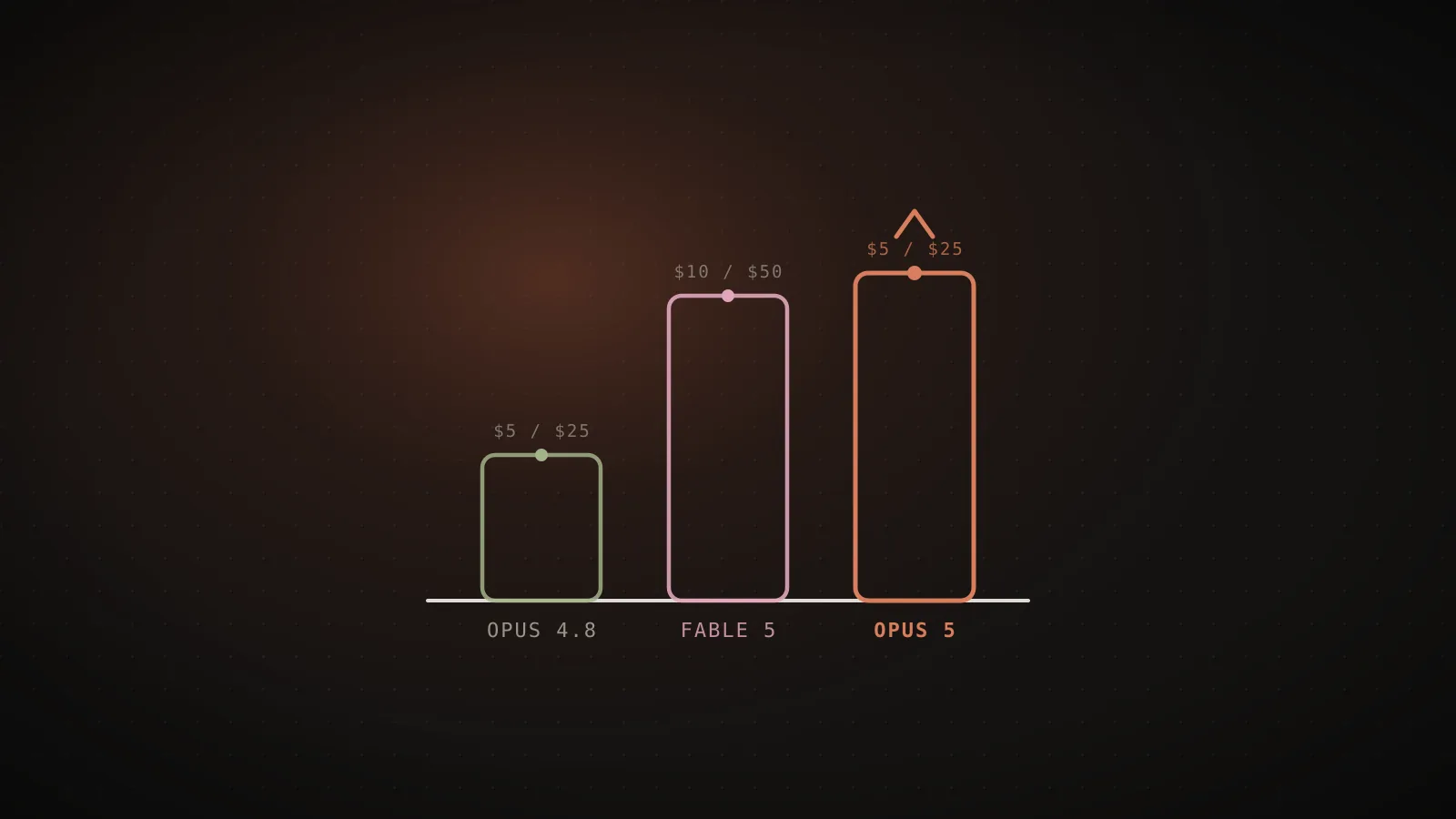
Claude Opus 5 is Anthropic's newest Opus-tier model, released July 24, 2026 at the exact same price as Claude Opus 4.8: $5 per million input tokens, $25 per million output. The upgrade is almost entirely in capability, not cost - Anthropic says it more than doubles Opus 4.8's score on its own Frontier-Bench evaluation and lands within 0.5% of Claude Fable 5's peak CursorBench 3.2 result at roughly half Fable 5's price. It's meant as a drop-in replacement for claude-opus-4-8 in your code, but two behavior changes - adaptive thinking now runs by default, and it ships with its own safety classifier - can break existing requests and change how it acts inside Claude Code.
TL;DR: Same price as Opus 4.8 ($5/$25 per million tokens), a reported 2x-plus jump on Frontier-Bench, and a CursorBench 3.2 score within half a percentage point of Fable 5's - at half Fable 5's price. The catch for anyone calling the API directly: thinking is on by default now (it wasn't on Opus 4.8), disabling it is capped at effort
high, and Opus 5 carries a cyber-category safety classifier that Opus 4.8 never had. If you're on Claude Code and were already defaulting to an Opus model, switching costs you nothing on price and should read as a straightforward upgrade - just don't assume old API code ports over unchanged.
Claude Opus 5 vs Opus 4.8 vs Fable 5: the numbers
Price per 1M tokens
input / output
Context window
tokens
Max output
tokens per request
Reliable knowledge cutoff
per Anthropic's models overview
Safety classifiers
can decline a request
Adaptive thinking
on API requests with no thinking field
Read from Anthropic's models overview, the Opus 5 migration guide, and the refusals-and-fallback docs on July 26, 2026. Fable 5's 1,000,000-token window buys less real room than the raw number implies: Anthropic's own tooltip on that row says its tokenizer produces roughly 30% more tokens than Opus 5 or Opus 4.8 for the same text.
The price row is the whole story in one line: Opus 5 didn't get more expensive to get dramatically more capable, it just replaced Opus 4.8 at the same $5/$25 rate. The knowledge-cutoff row is worth checking before you rely on either model for anything time-sensitive - Opus 5's "reliable" cutoff runs to May 2026, four months past Opus 4.8 and Fable 5's January 2026 mark. And the safety-classifier row is the one detail that's easy to miss if you only read the pricing and benchmark headlines: Opus 4.8 shipped with no classifier at all, so code that never had to handle a refusal from an Opus model will need to now.
What's actually new in Claude Opus 5
Anthropic's launch post leans on five evaluations, and none of them are the familiar SWE-Bench or Terminal-Bench numbers the earlier Fable 5 and GPT-5.6 Sol launches quoted. On Frontier-Bench v0.1, Anthropic says Opus 5 "more than doubles Opus 4.8's performance at a lower cost per task." On ARC-AGI 3, the reported score is "three times as high as the next-best model." On Zapier AutomationBench, a benchmark built around real automation workflows rather than coding tasks specifically, Opus 5's pass rate comes in "around 1.5x the next-best model." And on OSWorld 2.0, a computer-use benchmark, Anthropic reports Opus 5 surpassing Fable 5's best result outright, at just over a third of Fable 5's cost.
The Opus-4.8 comparison gets more specific in two domains Anthropic calls out by name: organic chemistry (+10.2 points) and protein-structure prediction (+7.7 points), both framed as life-sciences use cases rather than general coding gains. Anthropic also describes Opus 5 as more token-efficient, using fewer reasoning tokens than Opus 4.8 to reach an answer - which matters more than it sounds, since Opus 5 now runs with thinking on by default (more on that below).
What breaks if you're calling Opus 5 through the API
What breaks if your code still expects Opus 4.8
Six behavior changes, from Anthropic's own migration guide
Thinking runs by default
A request with no thinking field ran without it on Opus 4.8. The same request on Opus 5 runs with adaptive thinking on, and thinking tokens count against your max_tokens.
Disabling thinking caps your effort
thinking: {type: "disabled"} still works, but only at effort high or below. Combine it with xhigh or max effort and the request now returns a 400 error.
A cyber-category safety classifier ships with it
Opus 4.8 had no classifier at all. A cyber-flagged Opus 5 request declines with stop_reason: "refusal" unless you've set up fallback to Opus 4.8.
Prompt caching kicks in earlier
The minimum cacheable prompt drops from 1,024 tokens to 512. Short prompts that couldn't cache on Opus 4.8 can now create cache entries with no code changes.
Tools can change mid-conversation (beta)
Add or remove tools between turns without invalidating your prompt cache hits - useful for agents that expose tools progressively instead of all at once.
Responses run longer by default
Anthropic's own migration notes say lowering effort won't reliably shorten visible output. Prompt explicitly for conciseness or a target length instead.
None of these six are exotic edge cases - they're the differences Anthropic's own "Migrating from Claude Opus 4.8 to Claude Opus 5" guide leads with, because they're the ones most likely to silently change behavior in code that was tuned for Opus 4.8. The thinking-on-by-default change is the one worth testing first: any prompt that assumed a fast, thinking-free response now gets adaptive reasoning inserted ahead of it, which changes both latency and how much of your max_tokens budget is left for the actual answer.
Does Claude Opus 5 have safety classifiers like Fable 5?
Partially, and this is the detail general coverage of the launch tends to skip. Anthropic's refusals-and-fallback documentation now names Claude Fable 5 and Claude Opus 5 as the two current models with safety classifiers that can decline a request outright - Opus 4.8 was never on that list. Specifically, Anthropic's migration guide says Opus 5 "ships with cybersecurity safety classifiers whose cyber-category refusals can fall back to Claude Opus 4.8." A declined request comes back as a normal stop_reason: "refusal" response, not an error, and if you've set up the beta fallbacks parameter or the SDK's refusal-fallback middleware, Anthropic's documented default routes a refused Opus 5 request to Opus 4.8 to try again. If your Claude Code setup or CI pipeline has security-tooling code in it, this is worth testing deliberately rather than discovering the first time a request comes back empty - the same way Fable 5's broader classifier coverage already catches cybersecurity and biology work today.
Should Claude Code users switch to Opus 5?
If you were already defaulting to Opus 4.8 for coding or enterprise work - which was Anthropic's prior guidance - Opus 5 reads as a straightforward upgrade: same price, better reported scores across the board, no reason to stay on the older model once you've confirmed your code handles the two API changes above. Reach for Fable 5 specifically when a task falls into the areas Anthropic still credits it with leading: offensive cybersecurity work and biology research, the same two domains where its classifier coverage is broadest. For everything in between - the bulk of day-to-day coding, agentic, and knowledge work most Claude Code users are doing - Opus 5's own numbers argue it's now close enough to Fable 5 to make the price gap hard to justify.
Honest limits of this comparison
Every benchmark number above is Anthropic's own reported result, not an independent third-party score - Frontier-Bench, ARC-AGI 3, Zapier AutomationBench, and OSWorld 2.0 are all vendor-run evaluations from the launch post itself. I deliberately didn't pull a live aggregator index score (the kind earlier model comparisons on this site have cited) for Opus 5, because I couldn't confirm one was current as of this writing rather than still reflecting pre-launch data - re-check before you cite a specific index rank. This also doesn't cover Claude Mythos 5, which shares Fable 5's specs and pricing but is invitation-only through Anthropic's Project Glasswing. And Anthropic's own docs don't spell out whether Opus 5 has taken over as the default model for every Claude Code account tier (Pro, Max, Team, Enterprise) the way Opus 4.8 previously was - check /status inside your own session rather than assuming.
FAQ
What is Claude Opus 5?
Claude Opus 5 is Anthropic's newest Opus-tier model, released July 24, 2026. It's positioned as a drop-in upgrade for Claude Opus 4.8 at the same price, and Anthropic reports it more than doubles Opus 4.8's score on the company's own Frontier-Bench evaluation while landing within 0.5% of Claude Fable 5's peak CursorBench 3.2 result at roughly half Fable 5's price.
How much does Claude Opus 5 cost?
$5 per million input tokens and $25 per million output tokens - identical to Claude Opus 4.8's pricing. Claude Fable 5 costs $10 and $50 per million tokens respectively, twice as much on both ends.
Is Claude Opus 5 better than Claude Opus 4.8?
On Anthropic's own reported benchmarks, yes and by a wide margin: more than double the Frontier-Bench score, double-digit point gains on life-sciences tasks, and lower reasoning-token usage, all at the same per-token price. It's not a pure drop-in for existing code, though - adaptive thinking now runs by default, and a new cyber-category safety classifier can decline requests Opus 4.8 never would have.
How does Claude Opus 5 compare to Claude Fable 5?
Close on raw capability, far apart on price. Opus 5 scores within 0.5% of Fable 5's peak CursorBench 3.2 result and beats Fable 5's best OSWorld 2.0 result outright, at roughly a third to half the cost per token. Fable 5 still leads on the tasks Anthropic singles out specifically: cybersecurity exploitation and biology research.
Does Claude Opus 5 have safety classifiers like Fable 5?
Yes, and that's new for the Opus line - Claude Opus 4.8 had none. Opus 5 ships with a cyber-category classifier; a flagged request declines with stop_reason: "refusal" unless you've configured fallback, in which case Anthropic's documented default routes it to Claude Opus 4.8.
What breaks if I upgrade from Opus 4.8 to Opus 5 in my own code?
Two things most commonly. First, requests that used to run without a thinking field now run with adaptive thinking on, which eats into your max_tokens budget. Second, if you explicitly disable thinking, you can no longer pair that with effort xhigh or max - that combination now returns a 400 error, so you have to drop to effort high or below.
This gap closes fast - re-pull the numbers before you plan around them
Opus 4.8 held the "start here" recommendation for less than six months before Opus 5 replaced it at the identical price point, and nothing about that pace is unusual for this field right now. Treat everything above as dated on purpose, not as a permanent ranking: re-check Anthropic's models overview and the migration guide directly before you write a workflow that depends on a specific number in the table above. What doesn't need re-checking every time a new model ships is the layer underneath it - your CLAUDE.md, your MCP server list, the skills you've kept. ClockedCode builds that layer once so switching from Opus 4.8 to Opus 5, or to whatever ships next, doesn't mean rebuilding your setup from scratch.