OpenCode vs Claude Code: Pick Your Model or Trust One Vendor
 By Neo Zino - builder of ClockedCode10 min read
OpenCode vs Claude Code compared on model access, pricing, and the GitHub org rename several 2026 posts still miss, with real CLI and repo numbers, not vibes.
Made with DispatchSEO
On this page
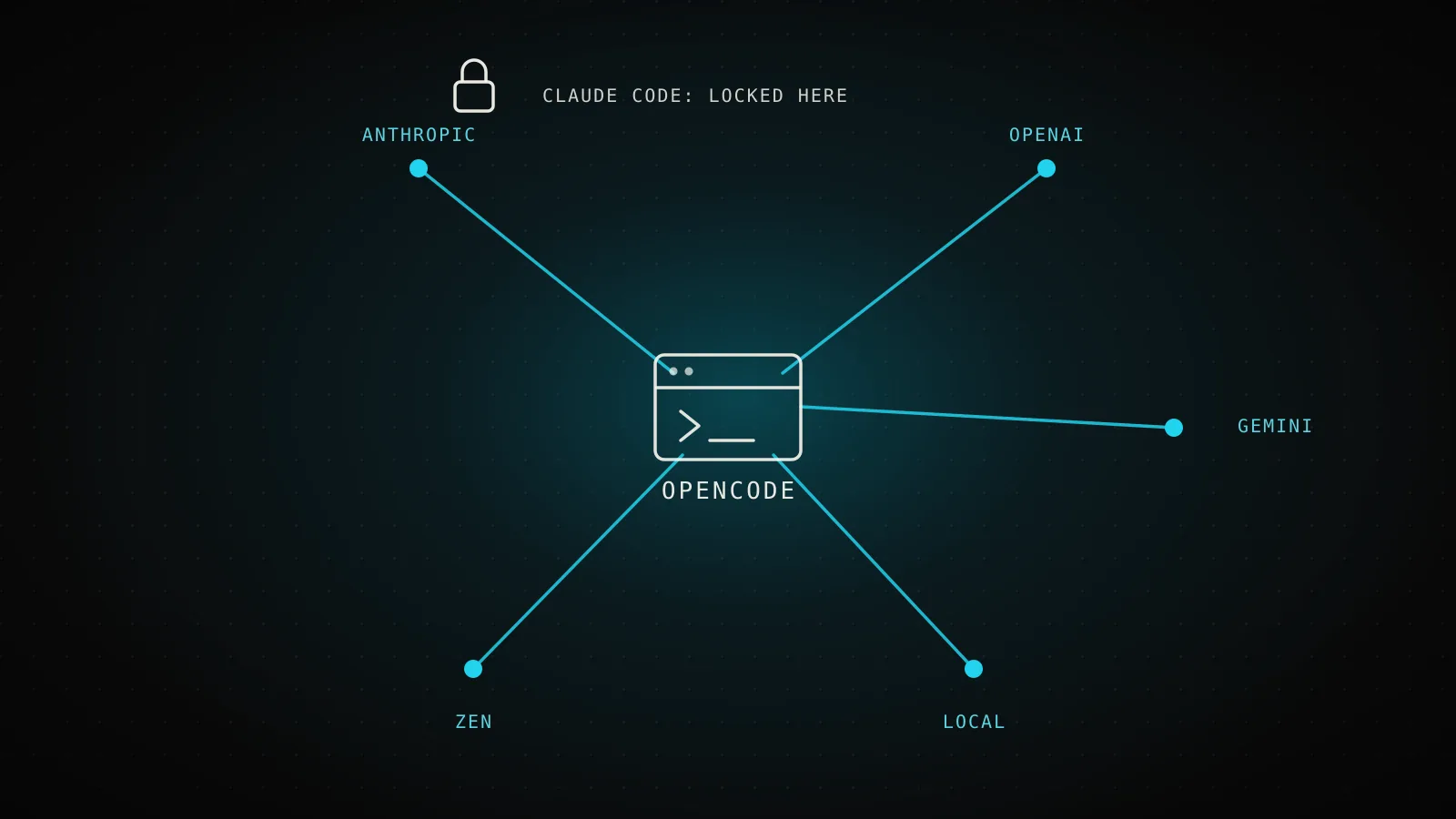
Point OpenCode at Ollama running fully offline, or at GPT-5.6 Sol, or at Claude itself - the tool doesn't care, because model choice isn't a plan tier, it's the entire premise. Claude Code makes the opposite bet: one model family, wired all the way through hooks, skills, and a persistent CLAUDE.md, with nothing to configure because there's nothing to choose. For this one I went straight to each project's own docs, GitHub's API, and pricing pages instead of leaning on the SERP's usual mix of Reddit threads and vendor blogs, and a couple of things there turned out to be stale.
TL;DR: OpenCode is free, open source (MIT), and runs on whatever model you point it at - Anthropic, OpenAI, Gemini, Bedrock, a local model through Ollama, or its own pay-as-you-go OpenCode Zen gateway. Claude Code is closed source, locked to Claude models, and starts at $17/month (Pro, annual) for the deeper native harness: subagents, hooks, skills, and a persistent CLAUDE.md. The fact most current comparisons miss: OpenCode's GitHub org quietly moved from
ssttoanomalyco, and Anthropic's own models run through both tools, just billed differently. Pick OpenCode if model choice or a fully local setup matters to you; pick Claude Code if you'd rather never think about the model and just get the deepest single-vendor setup available.
| OpenCode | Claude Code | |
|---|---|---|
| Interface | Terminal TUI, desktop app (beta), IDE extension | Terminal-native CLI, plus VS Code/JetBrains extension |
| License | Open source (MIT) | Closed source |
| Model access | Any provider, bring your own key | Claude models only |
| Starting price | Free (BYOK), or pay-per-token via Zen | $17/mo (Pro, annual) |
What OpenCode Is
OpenCode's own tagline is blunt: "the open source AI coding agent." The GitHub numbers hold that up - MIT-licensed, source public at github.com/anomalyco/opencode - which matters more here than it would for most tools, since the pitch is specifically that you can go check for yourself. Its primary surface is a terminal-based TUI, built to run in a modern emulator (WezTerm, Alacritty, Ghostty, Kitty), with a Tab key toggling between planning a change and actually building it. It also ships a desktop app currently in beta and an IDE extension, and installs through nearly every package manager you'd expect - npm i -g opencode-ai@latest, Homebrew, Scoop, Chocolatey, pacman, mise, Nix, or a one-line install script.
OpenCode doesn't ship a model of its own, so the real differentiator from one session to the next is whichever provider you've wired up: an Anthropic key, an OpenAI key, Gemini, Bedrock, or OpenCode Zen if you'd rather skip shopping for keys across five vendors and pay through one gateway instead. Project rules live in an AGENTS.md file you commit to the repo, and both MCP and LSP servers plug in for external tools and language intelligence.
What Claude Code Is
Claude Code starts as a CLI: install it, run claude in a project directory, and it reads the codebase, edits files, and runs commands from your terminal. Running claude --help against the CLI installed for this guide (v2.1.232) lists six --permission-mode values - plan, manual, dontAsk, acceptEdits, auto, bypassPermissions - plus --bg/--background, which starts a session as a background agent you check on later with claude agents, and -p/--print for piping a prompt through non-interactively. The same engine also ships as a VS Code and JetBrains extension and a desktop app, but the terminal stays the native surface.
There's no provider picker here. Claude Code runs Claude models only, and everything wrapped around it - subagents, hooks, skills, CLAUDE.md - was designed for that one model family from the start, rather than bolted onto something provider-neutral.
Model Access: Bring Your Own Key vs One Vendor
Bring your own key, any provider
Anthropic, OpenAI, Gemini, Bedrock, Vertex, and more
Local / self-hosted models
Point it at Ollama or another local runtime, no vendor in the loop
Curated pay-as-you-go gateway
OpenCode Zen: one API key, credits, no separate provider signups
Flat monthly subscription tiers
Pro/Max/Team usage limits instead of metered tokens
Open source codebase
MIT-licensed, source on GitHub
MCP server support
Connect external tools over Model Context Protocol
Rows sourced from each tool's own current docs, checked the day this guide was built. A dash means not documented as of that check, not a confirmed absence.
Every row tells the same story from a different angle: OpenCode trades away a built-in, pre-tuned model so you can plug in whatever provider fits the task, on a codebase you're free to inspect. Claude Code trades away that choice entirely so its harness - subagents, hooks, skills, CLAUDE.md - can be built around exactly one model family instead of a dozen.
Pricing: Pay-As-You-Go vs a Subscription
OpenCode's core usage costs nothing beyond whatever your chosen provider bills you per token - that's true whether you bring your own Anthropic or OpenAI key, or run a free local model through Ollama. For anyone who'd rather not manage several providers' billing separately, OpenCode Zen bundles them behind one API key: pay-as-you-go per request, with an auto-reload that tops up $20 once your balance drops below $5 (both configurable), workspace-wide or per-member spending caps, and a 4.4% + $0.30 fee on card top-ups. Zen's own pricing table ranges from several free models (DeepSeek V4 Flash Free among them) up through premium tiers like GPT 5.5 Pro at $30 input / $180 output per 1M tokens - Claude models sit in the middle, Haiku 4.5 at $1/$5 up to Fable 5 at $10/$50.
Claude Code, by contrast, runs a flat subscription ladder: Pro at $17/month (billed annually, $20/month monthly) covers everyday usage, Max starts at $100/month for heavier limits, and Team runs $20/seat/month annually. There's no metered pay-per-token option and no free tier, which is the price of the predictable, flat bill you get instead.
The Numbers Behind the "Open Source" Claim
anomalyco/opencode, verified
197,498
Stars
25,416
Forks
5,240
Open issues
MIT
License
The rename most comparisons miss: the repo shipped its early releases as sst/opencode. That URL now 302-redirects straight to anomalyco/opencode - same repo, new org - which several currently-ranking posts still cite under the old name.
"Open source" gets thrown around loosely in agent comparisons, so here's what it actually cashes out to for OpenCode right now: an MIT license, a public repo with real activity behind it, and a maintainer history that changed hands without most existing writeups catching up. Claude Code carries none of these numbers because there's nothing to check - it's closed source, and "how active is the repo" isn't a question you can ask about it.
Which One Fits Your Workflow
You already pay for several model APIs
And want to route each task to whichever model fits it
Bring your own key to any provider - Anthropic, OpenAI, Gemini, Bedrock - and switch per session
Data can't leave your machine
A fully local workflow is a requirement, not a nice-to-have
Runs against Ollama or another local runtime with no vendor in the loop at all
You've already tuned a CLAUDE.md, hooks, and skills
A deep single-agent setup you don't want to rebuild
Subagents, hooks, skills, and a persistent CLAUDE.md are first-party and combined, not bolted on
You're wiring an agent into CI or a script
Headless operation is the actual requirement
Terminal-native by design, with --print/-p and --bg for unattended background sessions
None of this needs to be an abstract philosophy question - it usually comes down to one or two concrete constraints you already have.
Where OpenCode Wins (And Where Claude Code's Limits Show)
No comparison should argue in just one direction, so here's the case for OpenCode on its own terms:
- Model freedom is real, not marketing. Move a task from Claude to a cheaper model, or to something running entirely on your own machine, without touching your workflow.
- You can actually read what it's doing. MIT licensing means the agent's request-and-response logic isn't a black box the way a closed-source tool's is.
- No subscription floor. A quiet month costs whatever tokens you burned, which can be zero on a free Zen model.
Claude Code's downside is the flip side of its focus: one vendor means one point of failure. If Anthropic raises prices, hits a rough patch, or throttles capacity during a busy week, there's no second provider to fall back on inside the same tool. Anyone who specifically wants to avoid that dependency has an easy out: run Claude's own models through OpenCode instead, and the fallback path to something else stays open without switching tools later.
Can You Run Both?
Yes. Since OpenCode treats Anthropic as just one provider among several, adding it next to Claude Code isn't really running two separate products, it's one extra install. A workable split: Claude Code stays the daily driver for the hook-and-skill-heavy work its harness was built for, and OpenCode comes out specifically when a task wants a different model, a fully offline run for something sensitive, or a cheaper option for a bulk mechanical change you don't want burning subscription-tier usage. Some developers skip the second subscription entirely and just run Claude's models through OpenCode's metered billing, if that math works out cheaper than their actual usage pattern.
FAQ
Is OpenCode free to use?
OpenCode itself is open source (MIT) and free to install. It runs bring-your-own-key, so you pay whichever model provider you connect - Anthropic, OpenAI, Gemini, and others - directly per token. The optional OpenCode Zen gateway is a curated, pay-as-you-go alternative to hunting down separate provider keys: you add credits, it auto-reloads $20 when your balance drops below $5 (configurable), and card top-ups carry a 4.4% + $0.30 processing fee. Several Zen models, including DeepSeek V4 Flash Free, are free.
Is OpenCode better than Claude Code?
That depends on what you'd rather not give up. OpenCode's entire design points at model freedom: bring any provider's key, run something fully local through Ollama, or route through OpenCode Zen's gateway, all inside an MIT-licensed codebase you're free to read. Claude Code trades that freedom for depth: lock to Claude models and you get subagents, lifecycle hooks, skills, and a persistent CLAUDE.md built specifically around them. If switching models mid-project is something you actually do, OpenCode fits better. If you'd rather never choose and just get the deepest single-agent setup available, that's Claude Code.
Who makes OpenCode?
Anomaly, under the GitHub organization anomalyco (repo: anomalyco/opencode). The project's early releases lived under the sst GitHub org - that old sst/opencode URL now redirects straight to the current anomalyco/opencode repo, a rename several still-ranking comparison posts don't reflect. As of this guide's build, the repo carries 197,498 stars, 25,416 forks, and 5,240 open issues under an MIT license.
Can OpenCode run Claude models?
Yes. Anthropic is just one of the providers OpenCode connects to - add your own Anthropic API key, or use OpenCode Zen's curated Claude tier, which prices models from Haiku 4.5 ($1 input / $5 output per 1M tokens) up to Fable 5 ($10 / $50). That's the wrinkle most "OpenCode vs Claude Code" framing misses: you can run Claude's models through either tool, just billed differently - metered per token in OpenCode, bundled into a flat Claude Code subscription.
Is Claude Code open source?
No. Claude Code is closed source, distributed as a CLI plus VS Code/JetBrains extensions and a desktop app, and it runs Claude models exclusively - there's no bring-your-own-key path to a different provider. What you get in exchange is a native extension surface (subagents, hooks, skills, CLAUDE.md) built and maintained by the same team that ships the models it runs on.
Can I use OpenCode and Claude Code together?
Yes. OpenCode treats Anthropic as just one provider among several, so pointing it at Claude models instead of a separate API costs nothing extra to set up. A workable split many people land on: Claude Code for the daily work that leans on subagents, hooks, and skills, OpenCode for the moments a task specifically needs a different or fully local model.
It's BYOK vs one vendor, not really OpenCode vs Claude Code
I keep landing on the same read after digging through both tools' docs and GitHub histories: the real axis here is bring-your-own-key versus one vendor, and OpenCode happens to let you run Claude anyway if that's the model you actually want. What decides it for you is narrower than the headline comparison suggests: do you need to swap providers mid-project, or would you rather never think about which model is running and just get the deepest possible harness around one? My own daily terminal is still Claude Code, mostly because the cheat sheet I keep next to it covers the flags I actually forget, but I've got OpenCode installed for the days a task needs a local model or a cheaper one. If it's an editor extension with the same BYOK freedom you're after rather than a terminal agent, Cline vs Claude Code walks through that version of the tradeoff, and what hooks actually do in Claude Code is worth reading if the native harness is the side of this you're leaning toward.