Devin vs Claude Code: The Real Differences
 By Neo Zino - builder of ClockedCode12 min read
Devin vs Claude Code compared on autonomy and pricing - updated for Devin's SpaceX AI models, free SWE-2 window, and Claude Code's newest permission flags.
Made with DispatchSEO
On this page
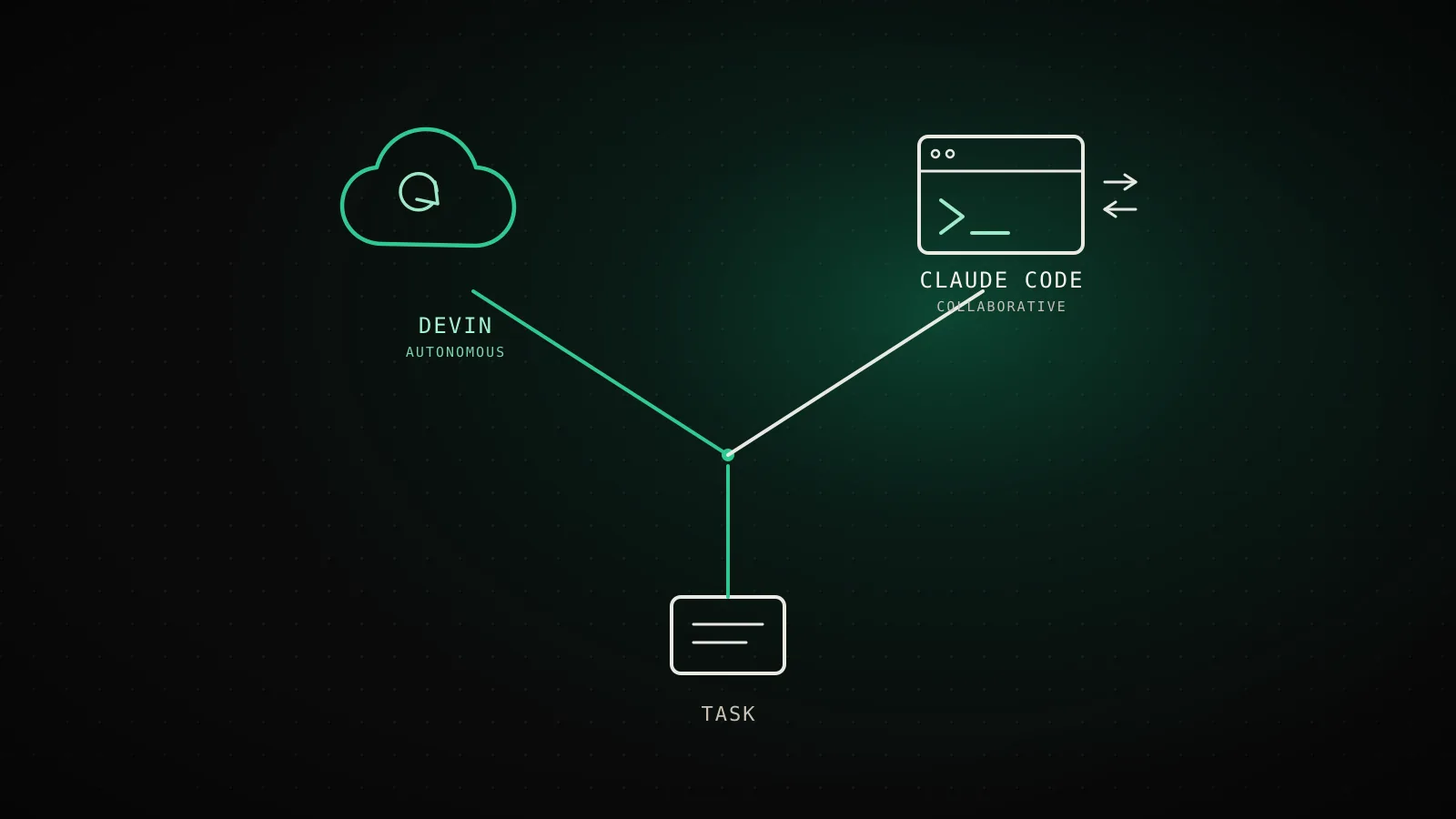
Devin hands off a whole ticket and hands back a pull request; Claude Code stays in the terminal with you, one turn at a time, through six permission modes you pick at session start. That split is the whole comparison: Devin bets a well-scoped task doesn't need a human watching, Claude Code bets most work is ambiguous enough to want steering. I re-verified both sides against their current docs and pricing pages on 2026-09-24 - Devin's pricing page picked up a new model (SpaceX AI) and a free SWE-2 window since this comparison first published, and re-running claude --help in this repo shows Claude Code now ships three more autonomy-adjacent flags than it did at launch.
TL;DR: Devin is a fully autonomous cloud coding agent - hand it a ticket via Slack, the web app, or its CLI, and it works the task unsupervised, handing back a PR when it's done; a $0/mo free tier exists to try it, something Claude Code has never offered. Claude Code is a terminal-native agent you run alongside, with six
--permission-modevalues (plan,manual,dontAsk,acceptEdits,auto,bypassPermissions) plus newer flags like--restrictedand--safe-modefor narrower control, and--bgfor when you want to walk away entirely; Pro starts at $17/mo (annual), with no persistent free tier. The overlap most comparisons miss: Devin's Pro tier now reaches OpenAI, Claude, Gemini, and SpaceX AI models (plus open-source options), and is running a free window on its own SWE-2 model through October 10, 2026 - so picking Devin doesn't necessarily mean giving up Claude's output, only Claude Code's native harness (subagents, hooks, skills, CLAUDE.md).
| Devin | Claude Code | |
|---|---|---|
| Interface | Web app, embedded IDE, terminal, Slack/Teams, CLI | Terminal-native CLI, plus VS Code/JetBrains extension |
| Autonomy model | Fully autonomous - works a task unsupervised | Collaborative - you steer via permission modes |
| Model access | OpenAI, Claude, Gemini, SpaceX AI + open source (paid tiers) | Claude models only |
| Starting price | $0/mo (Free tier) | $17/mo (Pro, annual) |
Devin: assign a ticket, get a PR back
Cognition's own docs describe Devin as an autonomous AI software engineer that "can write, run and test code," and the interface reflects that: a web app at app.devin.ai, an embedded IDE with real-time editing, a terminal for command execution, a browser for testing, and a standalone CLI for local use. What makes Devin distinct from an editor extension is how a task gets started - you tag Devin in a Slack or Teams thread, delegate through the web app, or fire it off from the CLI, and it goes to work in a cloud environment Cognition calls "cloud Devin." A /handoff command moves a task between that cloud environment and the local CLI mid-session, and every paid plan bundles Devin Desktop (the IDE Cognition built from its Windsurf acquisition, covered in more depth in Claude Code vs Windsurf), DeepWiki, the Devin API, and integrations with GitHub, GitLab, Slack, Jira, and Linear.
Claude Code: a terminal agent that works beside you, not instead of you
Claude Code starts as a CLI: install it, run claude in a project directory, and it reads the codebase, edits files, and runs commands from your terminal - git diff main --name-only | claude -p "review these changed files" is a normal command, not a special mode. The same engine also ships as a VS Code and JetBrains extension and a desktop app, but the terminal is the native surface, which is why it pipes cleanly into scripts and CI. Where Devin's default is a cloud environment you check in on, Claude Code's default is a session you're watching - the extension surface built around that (subagents, lifecycle hooks, skills, a persistent CLAUDE.md) exists specifically to make a long session useful without ever fully leaving your hands.
Autonomy vs control: who catches the mistake
Devin
Cognition wins hands-off autonomy
Assign a ticket, get a PR back
No mid-task supervision required
Task assignment from anywhere
Tag it in Slack, Teams, the web app, or the CLI
A real free tier
$0/mo to try before paying anything
Claude Code
Anthropic wins depth + control
Deeper native extension surface
Subagents, hooks, skills, a persistent CLAUDE.md
Granular permission modes
Six --permission-mode values, not one autonomy dial
Runs headless without a hosted dependency
Pipe a prompt from a script or CI, no cloud account needed
Both tools are betting on who catches a mistake first, and they bet opposite ways. Devin's bet is that a well-scoped ticket doesn't need a human watching every step, so it optimizes for handing back a finished result. Claude Code's bet is that most work is ambiguous enough to benefit from a human steering it turn by turn, so it optimizes for depth of control and a native extension surface instead of a hands-off mode.
Devin's guardrails vs Claude Code's --permission-mode flags
Autonomy, spelled out
Tested: Claude Code 2.1.282Devin's oversight model
Take over anytime
Jump into a running session and drive it yourself
Real-time monitoring
Watch the session as it works, not just the final diff
The three-hour rule
Devin's own docs: if a human could do it in three hours, Devin likely can
Claude Code --permission-mode
planmanualdontAskacceptEditsautobypassPermissionsPlus --bg / --background, which starts a background agent and returns immediately - managed afterward with claude agents. Newer since first publish: --restricted strips out command-running tools entirely, and --safe-mode disables every customization to isolate a broken config.
Devin's column is from docs.devin.ai's own autonomy guidance. The Claude Code column is the real output of `claude --help`, run in this repo and re-checked 2026-09-24.
Neither tool treats "autonomous" as reckless. Devin's own guidance leans on real-time monitoring and the ability to take over a session at any point, plus a rule of thumb worth quoting directly: "if you can do it in three hours, Devin can most likely do it." That's a scoping heuristic, not a safety mechanism - the actual check is you verifying the result (CI passing, a deploy working) after the fact, since Devin's docs don't describe a mandatory approval gate before it acts. Claude Code takes the opposite approach: autonomy is a named flag you set going in, from plan (nothing happens without your sign-off) through bypassPermissions (nothing stops it), with --bg sitting apart from that spectrum entirely as an explicit "start this and let it run" mode you check on later with claude agents (walked through in the background tasks guide).
Re-running claude --help today (CLI v2.1.282, up from v2.1.228 when this comparison first published) turns up three more dials Claude Code has added since: --restricted, which strips out the tools that run commands or code entirely rather than just gating them behind a permission mode - the same territory the sandbox mode guide covers; --safe-mode, which disables every customization (CLAUDE.md, skills, hooks, plugins) to isolate whether a broken config is the problem; and --bare, a minimal mode that skips hooks, plugin sync, and background prefetches for a stripped-down session. None of them replace the six permission modes - they sit alongside as narrower tools for narrower problems - but they extend the same asymmetry: Devin still describes its oversight as one dial, take over or don't, while Claude Code keeps adding more.
Pricing: a free tier vs none
Devin
- Free
- $0/molight quota, limited models
- Pro
- $20/mo+ SpaceX AI, free SWE-2 to Oct 10 '26
- Max
- $200/mosignificantly higher quotas
- Teams
- $80/mo + $40/devup to 200 seats
- Enterprise
- CustomSSO, VPC deployment
Claude Code
- Free
- Noneno persistent free tier
- Pro
- $17/mobilled annually ($20/mo monthly)
- Max
- $100/mo+5x-20x more usage than Pro
- Team
- $20/seat/moannual, includes Claude Cowork
Devin's free tier is the structural difference - Claude Code has never offered a persistent one, so trying it always means starting a paid plan. Above that entry point the ladders converge more than the headline prices suggest: Devin's Pro ($20/mo) and Claude Code's Pro ($17/mo annual) land close together, and team pricing is close too once you run the per-seat math (Devin's Teams tier caps at 200 seats; Claude Code's Team plan doesn't publish a seat ceiling). Devin's own pricing page has moved since this comparison first ran: Pro now lists "frontier models including OpenAI, Claude, Gemini, and SpaceX AI, plus leading open source models," and a free window on Devin's own SWE-2 model through October 10, 2026 - and a new Enterprise tier sits above Teams for SSO and VPC deployment. That means a Devin subscriber isn't locked out of Claude's output - they're choosing Devin's autonomous harness around whichever model they pick, the same way Claude Code locks you into Anthropic's models but hands you the deepest native harness built specifically around them.
When full autonomy backfires
Hand Devin a task with an ambiguous spec - "make the onboarding flow better" instead of a scoped ticket - and the three-hour rule stops being a helpful heuristic and starts being a guess about scope nobody validated. You get a PR back either way; the risk is reviewing a confidently wrong solution to the wrong problem, which costs more time than steering it would have. Claude Code has the inverse failure mode: an experienced developer approving every edit on mechanical, well-scoped work (a rename across 40 files, a dependency bump) is paying attention where none was needed, which is exactly the kind of task Devin's model - or Claude Code's own --bg flag - is built to take off your hands instead.
Picking the one that matches how you work
Pick Devin if you regularly have well-scoped, ticket-sized work you'd rather not watch happen, your team already lives in Slack or Jira where tagging an agent fits the existing flow, and a $0/mo tier matters before you commit a subscription to either tool. Pick Claude Code if your setup already has real weight behind it - a tuned CLAUDE.md, working subagents, hooks wired into CI - because none of that transfers, and you'd rather redirect ambiguous work mid-task than review a finished PR cold. The permissions guide covers how to configure that mid-task control in more detail, and the permissions generator turns it into a starter config instead of a blank settings file. If neither picture is exclusive for you, the wider field of alternatives covers where each tool - Devin's own desktop IDE included - earns a second install alongside Claude Code rather than instead of it.
FAQ
Is Devin better than Claude Code?
It depends on how much of a task you want to hand off completely. Devin's model is a ticket in, a pull request out, with no supervision required while it works - built for tasks scoped tightly enough that a human could do them in about three hours, per Devin's own guidance. Claude Code's model is a terminal agent you steer turn by turn, with six permission modes for exactly how much it does before checking in - built for messier, longer-horizon work you'd rather redirect mid-task than review only at the end. Pick the ticket-in-PR-out model and Devin wins; pick staying in the loop with a deeper native extension surface (subagents, hooks, skills, CLAUDE.md) and Claude Code wins.
Is Devin free to use?
Yes, there's a genuine $0/mo Free tier - a light usage quota, limited model availability, and unlimited inline edits and Tab completions, no credit card required. Paid tiers start at Pro ($20/mo, now reaching OpenAI, Claude, Gemini, and SpaceX AI models plus a free window on Devin's own SWE-2 model through October 10, 2026), then Max ($200/mo) for power users, Teams ($80/mo plus $40/mo per developer, up to 200 seats), and a custom-priced Enterprise tier with SSO and VPC deployment. Claude Code has no equivalent standing free tier: Pro starts at $17/mo billed annually ($20/mo monthly).
How autonomous is Devin, actually?
Devin's own documentation calls it an autonomous AI software engineer, but the docs are explicit that it's built for human oversight, not a black box: you can follow a session in real time, take over mid-task, and verify completion yourself (checking CI, testing the deployment) before trusting the result. Task assignment happens by tagging Devin in Slack or Teams, delegating through the web app, or using its CLI, and a /handoff command lets you move a task between the local CLI and the cloud version. The rule of thumb from Devin's own docs: if a human could finish the task in about three hours, Devin most likely can too.
What are Claude Code's autonomy controls compared to Devin's?
Claude Code exposes autonomy as an explicit session flag rather than one on/off switch. Running claude --help against the CLI installed for this guide (v2.1.282, re-checked 2026-09-24) lists six --permission-mode values - plan, manual, dontAsk, acceptEdits, auto, bypassPermissions - plus --bg/--background for a background agent you check on later with claude agents, --restricted to strip out command-running tools entirely, and --safe-mode to disable every customization for troubleshooting. Devin doesn't document an equivalent list of named modes; its autonomy is closer to a single dial (task in, PR out) with take-over and monitoring as the safety net, rather than Claude Code's growing set of graduated flags.
Should I switch from Claude Code to Devin?
Switch, or at least try Devin's free tier, if you have well-scoped tasks you'd genuinely rather not watch happen - the kind Devin's own three-hour rule is built around - and the multi-channel task assignment (Slack, web, CLI) fits how your team already works. Stay on Claude Code if your setup already leans on subagents, hooks, and a tuned CLAUDE.md, since none of that transfers, or if the work is ambiguous enough that you'd rather redirect it mid-task than review a finished PR cold. They're not strictly exclusive either: Devin's Pro and higher tiers now include access to Claude models alongside OpenAI's, Google's, and SpaceX AI's, plus a free window on Devin's own SWE-2 model through October 10, 2026 - so a Claude-quality result is available inside a Devin session too - you're choosing the harness around the model, not necessarily the model itself.
The three-hour question
Every "vs" comparison eventually asks you to pick a side. Devin's own docs frame a narrower, more useful question instead: could a human finish this specific task in about three hours? Answer yes often enough and a ticket-in, PR-out agent is worth the subscription on its own. Answer no, or "it depends on what I find once I'm in there," and you want the tool built to be redirected mid-task, not reviewed after the fact. My own setup stays Claude Code first, mostly because what ClockedCode ships is built to make that terminal session useful from the first prompt - but Devin's free tier costs nothing to point at one well-scoped ticket and see which answer you actually get.