Claude Code vs Windsurf: Which Fits Your Workflow (It's Now Devin Desktop)
 By Neo Zino - builder of ClockedCode8 min read
Claude Code vs Windsurf compared on architecture, agents, and pricing - plus the June 2026 rename to Devin Desktop and what actually replaced Cascade.
Made with DispatchSEO
On this page
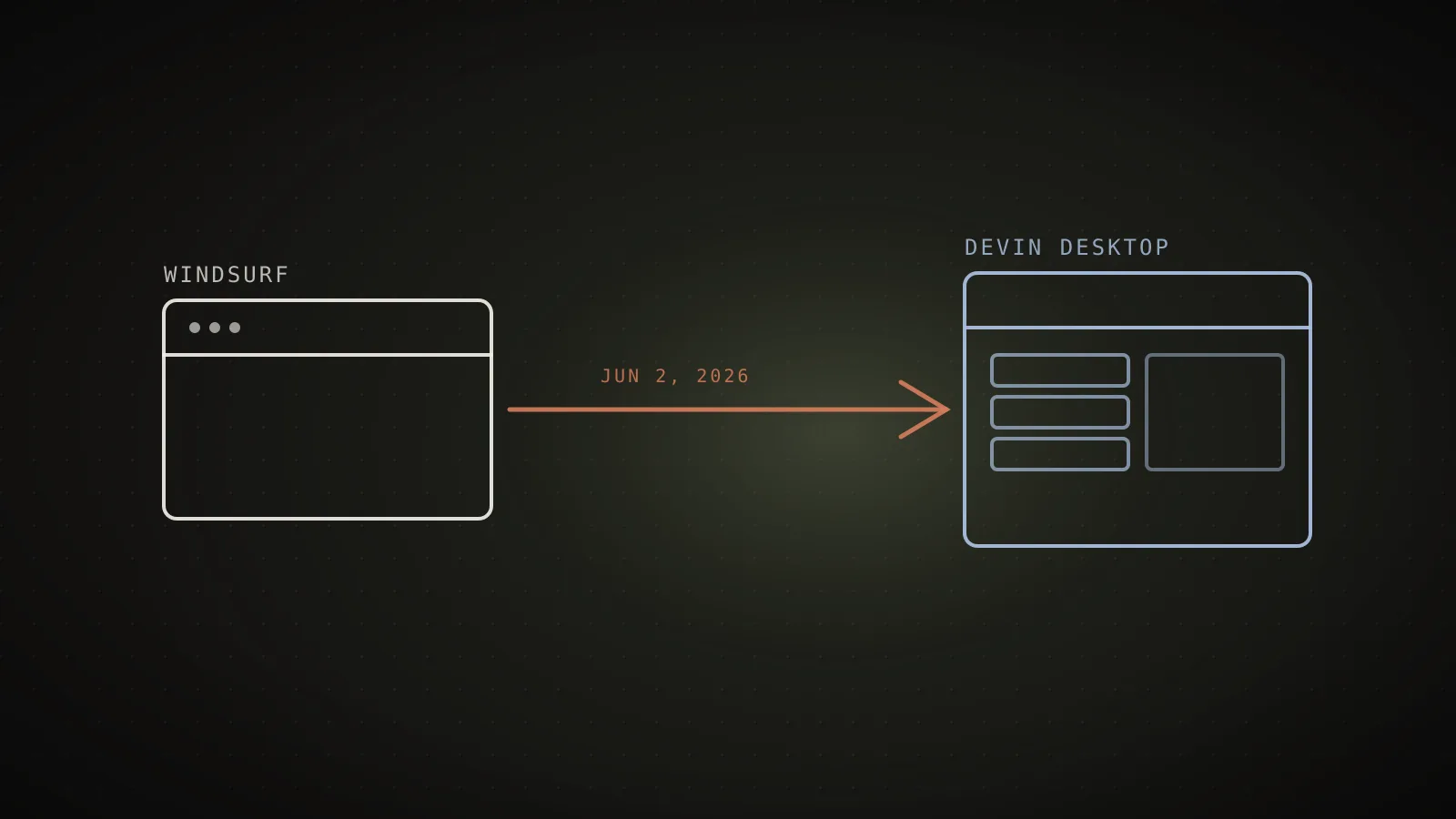
Windsurf became Devin Desktop on June 2, 2026, and the Cascade agent it built its reputation on reached end of life a month later - so most existing "Claude Code vs Windsurf" write-ups are describing a product name that no longer routes anywhere on its own domain. The underlying comparison hasn't moved as much as that sounds: Claude Code is still a terminal agent you hand a task to and walk away from, and the tool built from Windsurf is still a full code editor, now organized around Cognition's Agent Command Center instead of a single built-in agent. I read both tools' current pricing pages and Cognition's own rename announcement before writing a word of this.
TL;DR: Windsurf was renamed Devin Desktop on June 2, 2026 (Cognition acquired it July 14, 2025); its Cascade agent reached end of life July 1, 2026, replaced by Devin Local. Claude Code stays a terminal-first CLI with no persistent free tier (Pro from $17/mo annual) and the deepest native extension surface of any coding agent - MCP, subagents, hooks, CLAUDE.md. Devin Desktop is a full IDE with a $0/mo free tier, and its Agent Command Center can run Devin Local, Claude Agent, or Codex side by side over the open Agent Client Protocol. If your work is one big, ambiguous change you'd rather review after the fact, Claude Code fits. If you want a single editor managing several agents on several tasks at once, Devin Desktop fits - and you can point it at Claude Code itself to get both.
What "Windsurf" actually is today
What "Windsurf" actually is today
Jul 14, 2025
Cognition acquires Windsurf
Windsurf keeps operating under its own name and Cascade agent.
Jun 2, 2026
Windsurf becomes Devin Desktop
Same editor, same plans - the Agent Command Center is now the default surface.
Jul 1, 2026
Cascade reaches end of life
Succeeded by Devin Local, a Rust rewrite with subagent support.
None of this was a shutdown. Cognition's own announcement is explicit that plans, pricing, and the editor itself - extensions, keybindings, LSPs, workflows - carried over automatically, "backwards-compatible with Windsurf and VSCode." What changed is the default surface: instead of opening on the editor canvas with Cascade running underneath, Devin Desktop opens on the Agent Command Center, a Kanban board of every local and cloud agent's sessions. If you searched "claude code vs windsurf" expecting a straightforward IDE-vs-CLI comparison, the IDE side just got a second layer on top of it.
Terminal agent vs full IDE: the structural difference
Claude Code starts as a CLI - install it, run claude in a project directory, and it reads the codebase, edits files, and runs commands from your terminal without an editor open at all. Run claude --version and you'll get a number back (2.1.220 as I write this); that's the whole surface area, plus VS Code, JetBrains, and desktop extensions layered on top for people who want them.
The tool built from Windsurf is the opposite shape: a full editor first, agents second. Devin Local (Cascade's Rust-rewritten successor) runs local with full permissions, but the Agent Command Center is what you actually see when it opens - a management layer for however many agents you have running, not a single assistant living in a sidebar.
| Claude Code | Devin Desktop | |
|---|---|---|
| Native interface | Terminal CLI, plus IDE/desktop extensions | Full code editor (Windsurf's, VSCode-compatible) |
| Default surface | The terminal session itself | Agent Command Center (Kanban across agents) |
| Native local agent | Claude Code's own agent | Devin Local (Cascade's successor) |
| Runs other agents | No - Claude models only | Yes - Devin Local, Claude Agent, Codex, OpenCode via ACP |
| Free tier | None | $0/mo (light quota) |
| Runs headless / CI | Yes, natively | Not the product's focus - it's an editor |
Ecosystem and pricing: where each one actually wins
Claude Code
Terminal-first wins ecosystem depth
Runs headless by default
CLI, CI, scripts, and piped input - no editor required
Deepest native extension surface
MCP servers, subagents, skills, hooks, CLAUDE.md
Long-horizon coherence
Built for a single big, ambiguous change, not multiple parallel agents
Devin Desktop
Full IDE (built from Windsurf) wins agent flexibility
Agent Command Center
Kanban view of every local and cloud agent's sessions at once
Runs more than one agent
Devin Local, Claude Agent, Codex, or OpenCode over the open ACP standard
Has a free tier
$0/mo to start, before Claude Code's Pro plan is even in the picture
Claude Code's edge is depth on one agent: MCP servers, subagents, lifecycle hooks, and a CLAUDE.md file that persists project knowledge across sessions - the same extension surface the Cursor comparison covers in more detail, none of which Devin Desktop's docs describe an equivalent for today. Devin Desktop's edge is breadth across agents: the Agent Client Protocol it launched with means the editor isn't locked to Cognition's own model, and a free tier gets you in the door before you've paid anything, which Claude Code has never offered.
Claude Code
- Free
- Noneno persistent free tier
- Pro
- $17/mobilled annually ($20/mo monthly)
- Max
- $100/mo+5x-20x more usage than Pro
- Team
- $20/seat/moannual, includes Claude Cowork
Devin Desktop
- Free
- $0/molight quota, limited models
- Pro
- $20/mofull model access, Devin Cloud
- Max
- $200/mosignificantly higher quotas
- Teams
- $80/mo + $40/devunlimited members
The pricing gap is bigger than the entry price suggests once you look at the full ladder. Claude Code has nothing between "pay $17/mo" and "don't use it"; Devin Desktop has a real free tier, then two paid steps above it. Where the two get closer is team pricing: Devin's Teams plan ($80/mo plus $40/mo per developer) and Claude Code's Team seats ($20/seat/mo annual, which also includes Claude Cowork) land in a similar range once you do the per-seat math for a team of five or more.
Can you actually run Claude Code inside Windsurf?
Yes, and this is the part most existing comparisons on this keyword can't cover because it postdates them. Devin Desktop launched with the Agent Client Protocol, an open standard, and Cognition's own announcement names Claude Agent as one of the agents available from day one, alongside Codex and OpenCode. That tracks with what Claude Code already supports elsewhere: Zed ships native Claude Code support through the same protocol, using an open-sourced claude-code-acp adapter under an Apache license, so an editor built to speak ACP doesn't need a bespoke integration to run it. In practice, the "vs" in this comparison isn't always exclusive - you can run Claude Code as one of several agents inside Devin Desktop's Command Center instead of choosing one tool for the whole workflow.
Which one fits your workflow
Pick Claude Code if your day-to-day is one big, messy, multi-file change you'd rather delegate and review afterward than watch happen - long-horizon work is exactly what its terminal-first, headless design is built for, and a tuned CLAUDE.md is most of what separates a slow first session from a fast one. Pick Devin Desktop if you're already the kind of developer who wants several agents working different tasks at once and a single Kanban board to track them, especially if the $0/mo free tier matters before you've committed a subscription to either tool. Neither pick is permanent: since Devin Desktop can run Claude Agent as one of its ACP agents, trying both doesn't mean giving either one up.
When NOT to switch
Skip Devin Desktop if your Claude Code setup already has real weight behind it - a tuned CLAUDE.md, working subagents, hooks wired into CI - because none of that transfers, and rebuilding it inside a different tool costs more than the free tier saves. Skip Claude Code, or at least don't drop Devin Desktop for it yet, if you specifically rely on the Agent Command Center's multi-agent view; Claude Code has no equivalent for coordinating several running agents from one screen, since it's built around doing one thing well rather than managing several things at once.
FAQ
Is Windsurf now called Devin Desktop?
Yes. Cognition, which acquired Windsurf on July 14, 2025, renamed it Devin Desktop on June 2, 2026. Per Cognition's own announcement, the editor, extensions, keybindings, and pricing carried over unchanged - only the default surface and the brand changed, from a code-first IDE to an agent-management hub built around the same editor.
What happened to Windsurf's Cascade agent?
Cascade reached end of life on July 1, 2026, about a month after the rename. Its successor is Devin Local, a complete Rust rewrite Cognition says is up to 30% more token-efficient and adds subagent support Cascade never had.
Is Claude Code better than Windsurf (Devin Desktop)?
Neither wins outright - they're different shapes of tool. Claude Code is a terminal-first agent with the deepest native extension surface (MCP servers, subagents, hooks, CLAUDE.md) for long, autonomous changes. Devin Desktop is a full IDE built around managing multiple agents at once, including a free tier Claude Code doesn't have. Pick based on whether you want one deep agent or a command center for several.
Can I run Claude Code inside Windsurf (Devin Desktop)?
Yes. Devin Desktop launched with support for the open Agent Client Protocol (ACP), and Cognition's own announcement lists Claude Agent among the agents available at launch alongside Codex and OpenCode - the same open standard Zed uses to run Claude Code natively via its open-sourced claude-code-acp adapter.
How much does Devin Desktop cost compared to Claude Code?
Devin Desktop has a $0/mo free tier with a light quota, then $20/mo for Pro (full model access) and $200/mo for Max. Claude Code has no persistent free tier: Pro starts at $17/mo billed annually ($20/mo monthly), and Max starts at $100/mo. Team pricing is closer - Devin's Teams plan runs $80/mo plus $40/mo per developer, while Claude Code's Team seats are $20/mo each, annual.
The name changed; the question underneath it didn't
Search engines will keep surfacing "Windsurf" for a while yet, the same way people still say "Twitter" - but the product underneath the query is Devin Desktop now, and the actual decision is the one this comparison has always been about: one deep terminal agent you hand work to, or one editor managing several agents at once. That choice doesn't reset every time a vendor renames something. My own setup stays Claude Code first, mostly because what ClockedCode ships is built to make the terminal useful from session one - but nothing about Devin Desktop's Agent Command Center stops you from pointing it at Claude Code and getting both.