Amp vs Claude Code: Which One Actually Fits Your Team
 By Neo Zino - builder of ClockedCode12 min read
Amp vs Claude Code compared on modes, autonomy, team pricing, and Amp's new free Hobby tier, plus the July 2026 mode redesign most comparisons still miss.
Made with DispatchSEO
On this page
Sourcegraph rewired Amp's entire mode system in July and quietly added a free tier since, so most of what page one currently says about "Amp vs Claude Code" is already describing a version of Amp that doesn't exist anymore. Amp is Sourcegraph's coding agent, built around a shared team workspace - pooled billing, shared threads, multiplayer editing - and it routes each task across several models instead of committing to one vendor. Claude Code is Anthropic's terminal-native agent, locked to Claude models, built around the deepest native harness of any coding agent today. I pulled every claim below from each tool's own current docs and pricing pages rather than the usual roundup, starting with the mode redesign most existing comparisons haven't caught up to.
TL;DR: Amp (Sourcegraph) is built for a team working inside a shared workspace: pooled billing, shared and multiplayer threads, and a model-agnostic dial (low/medium/high/ultra, rebuilt July 9, 2026) that routes across GPT-5.6, Claude, and faster models depending on the task. A free Hobby tier now covers bring-your-own-key or pay-as-you-go use; paid subscriptions start at $20/month (Megawatt) or $200/month (Gigawatt), and usage-based billing beyond that is restricted to teams and enterprises. Claude Code is a terminal-first agent locked to Claude models, starting at $17/month (Pro, annual), with the deepest native extension surface around - subagents, hooks, skills, and a persistent CLAUDE.md carried across every surface it runs on. Pick Amp if you're buying for a team that wants to share threads and one billing pool; pick Claude Code if you want one deep, autonomous agent with the richest single-vendor ecosystem.
| Amp | Claude Code | |
|---|---|---|
| Maker | Sourcegraph | Anthropic |
| Interfaces | CLI, web UI, VS Code, Neovim, Zed | Terminal CLI, VS Code, JetBrains, desktop app, web, mobile |
| Model access | Multi-model (GPT-5.6, Claude, others), routed by mode | Claude models only |
| Team model | Shared/multiplayer threads, pooled billing | Subagents (one user, several agents), per-seat billing |
| Starting price | Free (Hobby, BYOK) or $20/mo (Megawatt) | $17/mo (Pro, annual) |
Amp's four-mode dial, rebuilt in July
Amp's mode dial, rebuilt July 9, 2026
Source: ampcode.com/manualLow
Fast, cost-efficient - straightforward edits
Medium
Balanced default for typical work
High
Deeper reasoning for harder problems
Ultra
Maximum capability, open-ended tasks
Amp routes each mode across multiple models - GPT-5.6, Claude Fable 5.1, and faster specialized models - rather than shipping one model per tier, plus an "Oracle" tool for deep reasoning on demand. Most comparison posts online still describe the old four-tier naming; this is the current one.
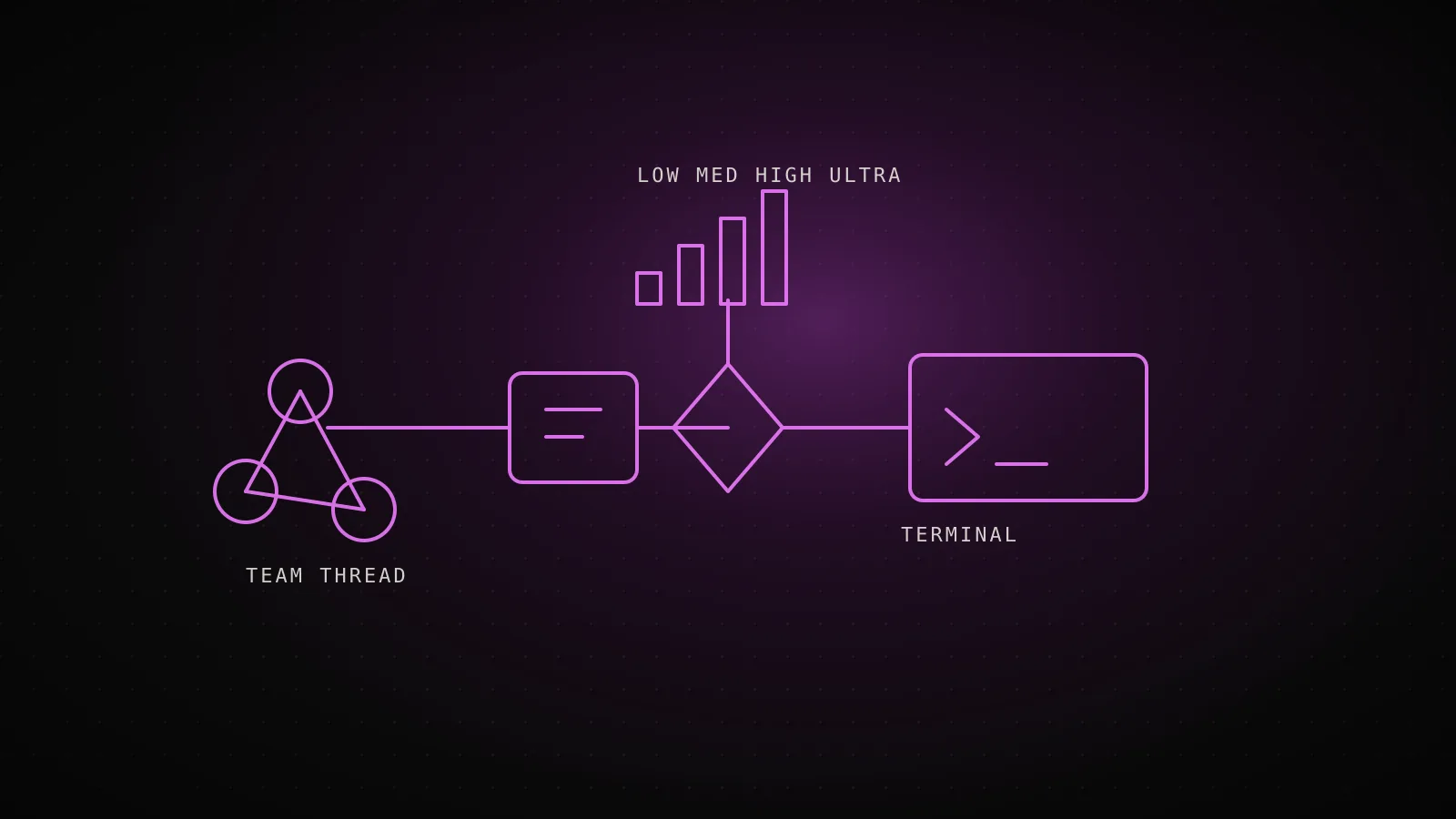
Amp replaced its old "smart / deep / rush / large" mode names with a four-step dial - low, medium, high, ultra - on July 9, 2026, and most of the small blogs, forum threads, and directory pages making up page 1 for this keyword predate that change. Per Amp's own manual, the dial isn't tied to a single model per tier: Amp routes work across GPT-5.6, Claude Fable 5.1, and faster specialized models depending on the task, plus an "Oracle" tool for deep reasoning on demand. Threads are first-class objects in Amp - saveable, shareable conversations that double as version control for what the agent did - and Amp spawns independent subagents for multifaceted work, though those subagents can't talk to each other directly, each running in its own isolated context window.
The CLI is built for scripting as much as chatting: amp -x "prompt" runs a single command non-interactively, echo "commit changes" | amp accepts piped input, and --stream-json emits line-delimited output for programmatic monitoring. Headless and CI use requires an AMP_API_KEY environment variable rather than an interactive login. Skills live in .agents/skills/ (or personal/workspace repositories) as SKILL.md directories with their own optional mcp.json, so a skill can bundle exactly the MCP servers it needs instead of loading everything globally - Amp's manual specifically recommends this over adding MCP servers workspace-wide, to keep the tool list manageable.
What Claude Code is, by comparison
Running claude --help against the CLI installed for this guide (v2.1.274) is a faster way to see what Claude Code actually is than reading its marketing page: six documented --permission-mode values, plus --bg/--background for background agents managed later with claude agents. That's the terminal surface, and it's still the native one, but per Claude Code's own docs the same engine also runs as a desktop app (macOS, Windows, Windows ARM64), a VS Code and JetBrains extension, a browser version at claude.ai/code, and a mobile app, all sharing the same CLAUDE.md files, settings, and MCP servers. Switch surfaces mid-task and nothing needs reconfiguring.
Where Amp bundles reusable knowledge into skills, Claude Code splits it two ways: CLAUDE.md, a file it reads at the start of every session for standards and architecture decisions, plus auto memory it builds on its own as it works - saving things like build commands and debugging insights across sessions without being asked. For recurring work, Routines run in the cloud on a schedule (created from the web, the desktop app, or /schedule in the CLI) and can also trigger on API calls or GitHub events, which is a step past Amp's own scheduling, restricted to Amp's own agents responding to events inside its workspace.
Autonomy: default execution vs six permission flags
Amp
Sourcegraph wins the workspace pitch
Shared threads across the team
Visibility controls: private, workspace-shared, group-shared
Pooled workspace billing
One credit pool an admin manages, not per-seat cards
Multiplayer editing
Simultaneous editing in shared, orb-backed threads
Claude Code
Anthropic wins the native harness
Deeper extension surface
Subagents, hooks, skills, and a persistent CLAUDE.md as one system
More surfaces, one engine
Terminal, VS Code, JetBrains, desktop, web, and mobile all share it
Auto memory across sessions
Builds its own notes on build commands and fixes as it works
The two tools default to opposite starting points. Amp executes tool calls without asking first - if you want a confirmation step, you add it yourself through a plugin's tool.call event handler, or fall back to Amp's older, still-supported permission configuration. Claude Code inverts that: autonomy is a session flag, not an opt-in add-on, with acceptEdits, auto, bypassPermissions, manual, dontAsk, and plan as the six documented --permission-mode values. Neither approach is strictly safer - Amp's default fits a team that already trusts the agent and wants it to move, while Claude Code's explicit modes fit workflows where different tasks call for different amounts of supervision. The permissions guide covers configuring Claude Code's modes in more depth, and the permissions generator turns a chosen mode into a starter settings file instead of a blank one.
Pricing: orb-hour credits vs a subscription ladder
Amp
- Hobby
- FreeBring your own keys, or pay-as-you-go per orb
- Megawatt
- $20/mo750 small-orb hours, no Amp token fees, low & medium modes
- Gigawatt
- $200/mo1,000 xxlarge-orb hours, no Amp token fees, all four modes
- Unconstrained
- Usage-basedTeams/enterprise only, per ampcode.com/pricing
Claude Code
- Pro
- $17/mobilled annually ($20/mo monthly)
- Max
- $100/mo+5x-20x more usage than Pro
- Team
- $20/seat/moannual, standard seat; $100/seat premium
Amp's billing shape is genuinely different from a flat subscription, and it changed again since this comparison first published: Amp's pricing page now leads with a free Hobby tier - bring your own model keys, or pay per orb with no subscription and no bundled Amp allowance either way. Above that, Megawatt ($20/month) buys 750 hours of "small orbs" and caps you to low and medium modes; Gigawatt ($200/month) buys 1,000 hours of "xxlarge orbs" and unlocks high and ultra. Both paid tiers now carry "no Amp token fees or limits" once you bring your own keys or a linked subscription - not a flat monthly credit the way the plans used to be described. Usage-based "Unconstrained" billing exists on top of the paid tiers, but per Amp's own pricing page it's for teams and enterprises whose usage doesn't fit a monthly plan - not an option an individual account can just pick instead. On August 10, 2026, Amp also shipped adaptive pricing that lets the dial adjust to a linked ChatGPT subscription, extending low/medium/high access to accounts that already pay for one. One quirk worth knowing before buying for a team: per Amp's own FAQ, "there's no way yet to automatically start a new subscription for each member" - an admin has to provision each one by hand, and each person can hold at most two subscriptions.
Claude Code's ladder is the more familiar shape: Pro at $17/month (billed annually, $20/month monthly) covers everyday usage, Max starts at $100/month for 5x to 20x more capacity, and Team runs $20/seat/month annually for standard seats or $100/seat/month for premium, both jumping to $25 and $125 respectively if billed monthly. Enterprise adds SCIM, audit logs, and a compliance API on top of Team, billed at $20/seat plus usage at API rates. Claude's own $0/month tier still covers chat only, not Claude Code - so the free-tier asymmetry this comparison used to describe has flipped: Amp's Hobby tier is now the one with a genuinely free path to the coding agent itself, provided you supply your own keys.
Where Amp's team pitch actually wins
A comparison that only argues one direction isn't worth much, so here's where the trade genuinely favors Amp:
- Pooled billing, one admin. A workspace credit pool instead of reconciling per-seat API bills across a team.
- Threads as shared, versioned objects. Set visibility to workspace-shared or group-shared and a teammate picks up exactly where the agent left off, with multiplayer editing on the same thread when two people need to work it at once.
- No single-vendor bet on models. Routing across GPT-5.6, Claude, and faster tiers means a bad day (or a price hike) from one provider doesn't stall every session.
Where Claude Code's depth wins instead
- One system, not several bolted together. Subagents, hooks, skills, and CLAUDE.md are a combined, first-party harness maintained by the same team shipping the models it runs on - Amp's plugins and skills cover similar ground but as separate pieces you assemble yourself.
- Every surface, one engine. JetBrains and a dedicated mobile app aren't in Amp's own interface list; Claude Code's CLAUDE.md, settings, and MCP servers carry across all six of its surfaces without reconfiguring anything.
- Auto memory that needs no prompting. Claude Code writes its own session notes as it works; Amp's equivalent (skills) has to be authored, even when Amp can generate the file for you on request.
When neither tool is the right call
If you're a solo developer with no one to share a thread with, Amp's whole pitch - pooled billing, multiplayer editing, shared visibility controls - is weight you're paying $20+/month for and never using; a single-seat tool fits better. If your team has a hard requirement to stay on one model vendor for compliance or procurement reasons, Amp's multi-model routing works against you rather than for you. And if a genuinely free way to try the tool matters, that calculus changed: Amp's Hobby tier now covers bring-your-own-key or pay-as-you-go use at no subscription cost, while Claude Code's free tier still stops at chat, not the coding agent itself - the wider field of alternatives covers a few more tools with a real $0/month entry point, and Cline covers the other end of "model-agnostic," running bring-your-own-key exclusively instead of offering a subscription at all.
Which one to install first
Pick Amp if you're buying for a team that actually wants to work inside the same agent session together - shared threads, pooled billing, and a model choice that isn't locked to whichever vendor you signed with first. Pick Claude Code if what you need is depth on one agent: the native extension surface Amp's plugin system approximates but doesn't bundle the same way, and a single engine that follows you from terminal to IDE to desktop to phone without reconfiguring anything. Most teams evaluating "Amp vs Claude Code" aren't actually choosing between two rival philosophies forever - Amp's own routing already sends work to Claude models some of the time, so testing it doesn't mean abandoning a Claude Code setup you've already tuned. If depth on one agent is what you're protecting, the CLAUDE.md ClockedCode generates is built to make that setup worth protecting from session one.
FAQ
Is Amp better than Claude Code?
It depends on whether you're buying for a team or for yourself. Amp's real pitch is a shared workspace: pooled billing, shared threads, and multiplayer editing built for several people working the same codebase. Claude Code's pitch is depth on one agent: the deepest native extension surface of any coding agent today (subagents, hooks, skills, a persistent CLAUDE.md) tuned by the same team that ships the models. Buying for a team that wants to work inside one shared thread, Amp wins that argument. Wanting one deep, autonomous agent with the richest single-vendor ecosystem, Claude Code wins it.
How much does Amp cost compared to Claude Code?
Amp added a free Hobby tier since this comparison first published: bring your own model keys or pay per orb-hour with no subscription, and the agent itself costs nothing. Its two paid tiers are Megawatt ($20/month: 750 hours of small-orb time, low and medium modes) and Gigawatt ($200/month: 1,000 hours of xxlarge-orb time, all four modes); usage-based billing beyond that is restricted to teams and enterprises. Claude Code's ladder is Pro at $17/month (billed annually, $20/month monthly), Max from $100/month for 5x-20x more usage, and Team at $20/seat/month (standard) or $100/seat/month (premium), both billed annually - and it still has no free tier for the coding agent itself, only for Claude's chat product.
Does Amp support Claude models?
Yes. Amp doesn't lock to one model provider - it routes work across several, including Claude Fable 5.1 and GPT-5.6, picking the model behind the scenes based on which of its four modes (low, medium, high, ultra) you're running. That's the opposite of Claude Code, which runs Claude models exclusively and has no bring-your-own-key path to a different provider.
Is Amp free to use?
Yes, as of Amp's current pricing page. A Hobby tier costs nothing: bring your own model keys, or pay-as-you-go per orb with no subscription at all. The paid Megawatt and Gigawatt tiers exist for people who'd rather not manage their own keys or usage-based billing. That puts Amp closer to Gemini CLI or Cline's bring-your-own-key mode than to Claude Code, which has no free path to the coding agent itself - only to Claude's separate chat product.
Can I use Amp and Claude Code together?
Yes, and Amp's own routing makes it less of a hard switch than it looks - Amp already sends some of its work to Claude models, so a Claude Code habit doesn't go to waste. A common split: Claude Code as the daily terminal driver for deep, single-session work, and Amp for the moments a task genuinely needs several people editing the same thread at once, which Claude Code's subagents don't cover the same way.