Claude Cowork vs Claude Code: What's Actually Different (And Do You Need Both)
 By Neo Zino - builder of ClockedCode9 min read
Claude Cowork vs Claude Code compared: what each does, pricing, permission modes, and whether a Claude Code developer needs both in 2026.
Made with DispatchSEO
On this page
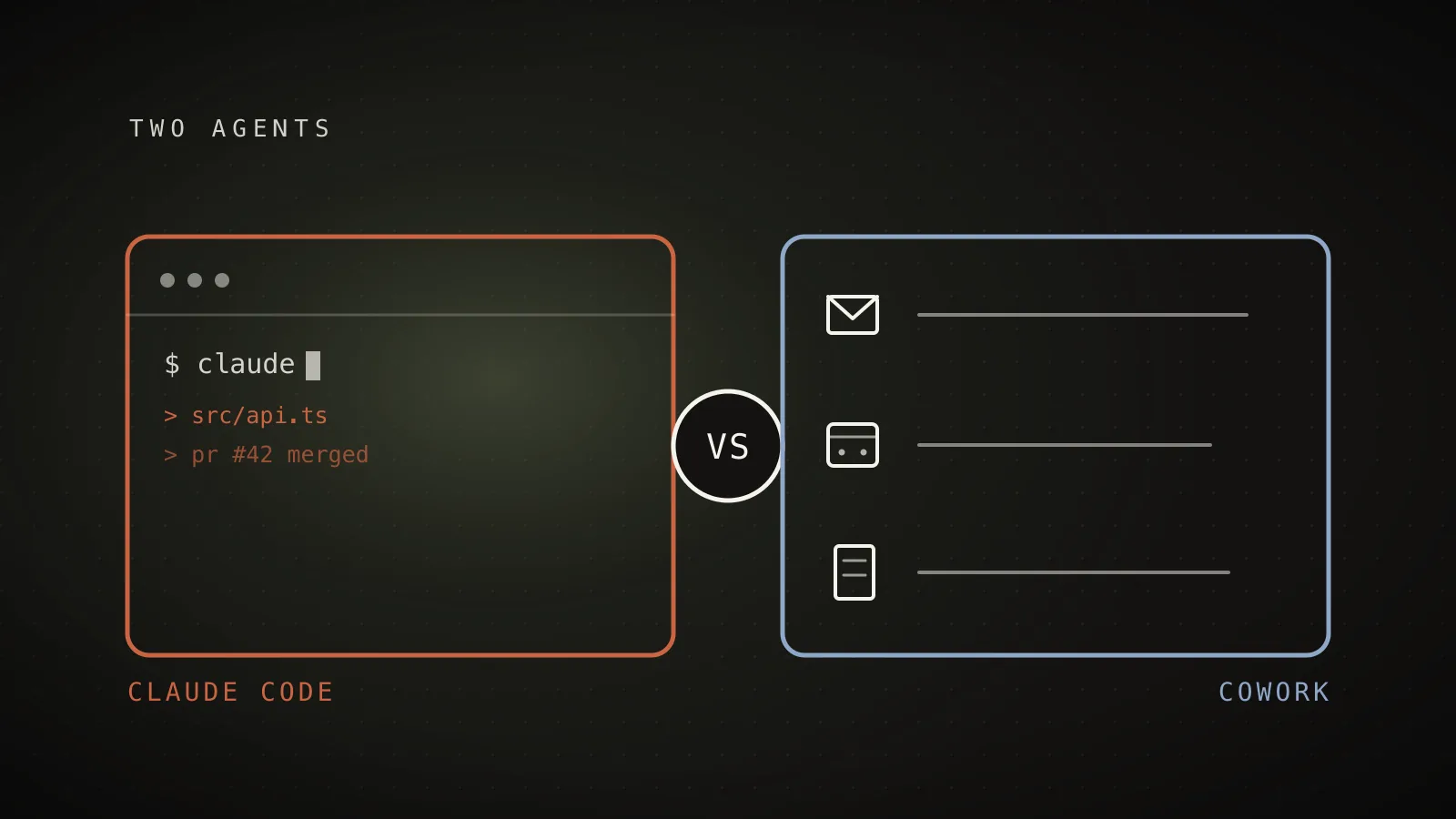
Claude Cowork and Claude Code share a company and, as of this month, a lot of the same headlines, so the mix-up is understandable. They are not the same product wearing two names. Claude Code is the terminal-native agent that lives in your repo, runs commands, and ships code. Claude Cowork is Anthropic's agent for the work that piles up around a job and isn't code at all: inboxes, calendars, spreadsheets, contracts, slide decks. I read Anthropic's own product pages and support docs for both, and ran the actual Claude Code CLI in this repo to check how much of Cowork's pitch it already covers.
TL;DR: Claude Cowork handles non-coding knowledge work - files, calendar, email, messaging apps, and the web - and Anthropic's own numbers say over 90% of Cowork sessions aren't software development. Claude Code stays the coding agent: terminal-native, repo-aware, with an MCP/subagent/hooks ecosystem Cowork doesn't have. The two run on different permission systems too - Cowork's Manual/Auto/Skip approval modes versus Claude Code's six
--permission-modevalues and its existing--bgbackground-agent flag, which already does most of what Cowork's "hand it off and walk away" pitch describes. If you code for a living, don't drop Claude Code. Add Cowork only if the non-coding work around your job is the part actually costing you time.
What is Claude Cowork, and how is it different from Claude Code?
Claude Cowork
Office & knowledge work
Files & documents
Docs, sheets, slides, PDFs, notebooks - reads, edits, creates
Calendar & email
Scheduling, inbox triage, contract review
Messaging apps
Connected chat tools, read and act on threads
The web & connectors
Browser automation plus any tool you connect
Claude Code
Software engineering
Your repo
Reads, edits, and runs commands in real, messy codebases
The terminal
CLI-native - pipes, scripts, and CI, not just a chat window
MCP servers
Open protocol - connect any external tool or data source
Subagents
Delegate side tasks to an isolated context window
Hooks
Run shell commands automatically on lifecycle events
Cowork rows from claude.com's own product page. Claude Code rows from code.claude.com's docs. Same company, two different jobs.
The split is structural, not a feature gap either side is racing to close. Claude Code's whole design centers on a codebase: it reads your repo, runs your test suite, and extends through MCP servers, subagents, and hooks that only make sense in a coding context. Claude Cowork centers on the tools a knowledge worker already has open - Anthropic's own product page lists Word-, Excel-, and PowerPoint-format files, PDFs, images, and Jupyter notebooks as things it reads, edits, and creates directly, plus connected calendar, email, and messaging apps it can act inside.
That 90% figure says what Cowork is for. Anthropic's launch post for the web and mobile beta names business operations and content creation as the two biggest categories, with examples like expense reconciliation, contract analysis, and client presentation prep. None of that touches a git repository, and none of it is what a Claude Code developer opens a terminal to do.
Claude Cowork vs Claude Code: pricing and platform availability
| Claude Cowork | Claude Code | |
|---|---|---|
| Included on | Pro ($17-20/mo), Max, Team, Enterprise | Pro ($17-20/mo) and up |
| Free tier | Not available | Not available |
| Platforms | Desktop (macOS, Windows, Linux, ChromeOS), web (beta), mobile (beta) | CLI, VS Code / JetBrains extensions, desktop app, web |
| Runs unattended | Yes, on web/mobile - stays running after you close your laptop | Yes - headless via -p, or backgrounded with --bg |
| Usage cost | Consumes allocation noticeably faster than standard chat | Standard Claude Code usage, same subscription |
Cowork's web and mobile beta started rolling out July 7, 2026, to Max plan users first, with broader plan access following in the weeks after - before that, Cowork was desktop-only. Both products require a paid plan; neither is available on Claude's free tier. The overlap in the table is the platform reach, not the job each one does: Cowork spreading to mobile means you can kick off a non-coding task from your phone, not that Claude Code review moved to your phone too.
Does Claude Code already do what Cowork's pitch describes?
Cowork's headline pitch is "hand Claude a task and walk away" - three approval modes deciding how much it checks with you, and background execution on web and mobile that keeps running after you close your laptop. Claude Code developers have heard a version of that pitch before, because a chunk of it already shipped in the CLI.
How much rope each one gets
Tested: Claude Code 2.1.216Claude Cowork
Manual
Claude pauses and asks for approval before acting
Auto
Acts after a safety review; blocks unsafe actions
Skip
Never pauses - nothing checks its actions automatically
Claude Code --permission-mode
planmanualdontAskacceptEditsautobypassPermissionsPlus --bg / --background, which starts a background agent and returns immediately - managed afterward with claude agents.
Cowork modes from claude.com's own product page. The Claude Code column is the real output of `claude --help`, run in this repo.
Cowork's three modes are genuinely simple: Manual pauses for your approval on every action, Auto acts after an internal safety review and blocks anything flagged unsafe, and Skip does neither. Claude Code's --permission-mode flag covers similar ground with more granularity - plan for review-only, manual and dontAsk for two shades of prompting, acceptEdits for auto-approving file changes specifically, auto for a broader auto-approve, and bypassPermissions as the closest analog to Skip. None of the writeups covering this keyword list the actual flag names, which is worth stating plainly since it changes the "walk away" narrative: Claude Code already has a background-agent flag (--bg / --background), managed afterward through claude agents, that starts a task and returns control immediately - the same "close your laptop, it keeps going" behavior Cowork is marketing as new, just for coding tasks instead of office ones.
That doesn't make Cowork redundant. It means the actual news in "Claude Cowork vs Claude Code" isn't autonomy - Claude Code had that - it's Anthropic building a second agent, on a second permission model, aimed at a completely different job.
When should a Claude Code developer reach for Cowork?
Reach for Cowork when the task is real work but not code: reconciling an expense report before a deadline, pulling the terms out of a vendor contract, turning a rough outline into client-ready slides, or triaging an inbox that's gotten away from you. These are the kinds of tasks Anthropic's own examples name, and they're exactly the category Claude Code has no purpose-built surface for - you could technically ask Claude Code to draft a PowerPoint outline, but you'd be fighting a tool built for diffs and test suites, not slides.
Stay in Claude Code for anything that touches your repo: writing features, fixing bugs, reviewing a PR, running your test suite, anything that benefits from MCP servers or a tuned CLAUDE.md. That boundary doesn't move just because Cowork can technically open a code file - Anthropic's own positioning keeps Claude Code as the software engineering surface and Cowork as the "work around the work" surface, and nothing in either product's launch materials argues otherwise.
When NOT to use either one
Neither product is a good fit for tasks that need a human's judgment on every step - a first-time skim of a legal contract you don't yet understand, or a codebase change you can't afford to get subtly wrong without review. Cowork's Skip mode and Claude Code's bypassPermissions both exist for a reason, but reaching for either as a default habit, instead of the situations that call for it, is how mistakes ship unnoticed. And don't install Cowork expecting it to replace project management or a real CRM - it completes tasks inside the tools you connect, it doesn't become a new system of record.
Do you need both?
Probably, if your job includes both kinds of work - most developers' jobs quietly do, even if the non-coding half doesn't feel like "real work" at the time. Claude Code stays the tool for the part of your job that is code: it's the one with the MCP servers, the subagents, the CLAUDE.md, the whole ecosystem built for a repo. Cowork is worth adding on top specifically for the administrative half that eats real hours and has no good agent today - not as a replacement, as a second tool for a job Claude Code was never trying to do. A tuned Claude Code permission setup is still the thing that makes the coding half of that stack actually safe to run unattended, which is where most of the setup work should go first.
FAQ
Is Claude Cowork the same product as Claude Code?
No. Both come from Anthropic and both run agentically, but they're built for different jobs. Claude Code is a terminal-native coding agent that reads, edits, and runs commands in a real codebase. Claude Cowork works across files, calendar, email, messaging apps, and the web to complete non-coding tasks - Anthropic's own figures put over 90% of Cowork usage outside software development.
Can Claude Cowork write and ship code like Claude Code does?
Cowork can open and edit code files since they're in its supported file-type list, but it isn't built around a repo, a terminal, or a test loop the way Claude Code is - there's no MCP ecosystem, no subagents, no hooks, no CLAUDE.md. For actual software engineering work, Claude Code is the tool Anthropic itself points to.
Does Claude Code already support unattended, background agents like Cowork?
Yes. Running claude --help against the current CLI (v2.1.216) shows a --bg/--background flag that starts a background agent and returns immediately, managed afterward with the claude agents command, plus six --permission-mode values from plan up to bypassPermissions. Claude Code has had a walk-away mode for a while - Cowork's web/mobile launch just marketed the same idea for non-coding work.
Which plans include Claude Cowork?
Pro, Max, Team, and Enterprise. Free-tier accounts don't get Cowork at all, and it consumes usage allocation faster than a normal chat session. The web and mobile beta rolled out starting July 7, 2026, to Max users first, with wider plan access following in the weeks after.
Should I replace Claude Code with Claude Cowork?
No - they're not substitutes. If your daily work is writing and shipping code, stay on Claude Code; nothing about Cowork's launch changes that. Cowork is worth adding on top when the work piling up around your coding job - inbox triage, contract review, deck prep - is eating time you'd rather spend building.
The name is the confusing part, not the products
Once you separate the products from the shared branding, this stops being a hard call: Claude Code for the repo, Cowork for the inbox, and neither one asking you to give up the other. What's actually new here isn't autonomy - Claude Code has had a background-agent flag this whole time - it's Anthropic shipping a second agent for the half of the job that never had one. If you're already running Claude Code daily, the useful move isn't switching, it's making sure the coding half of your stack is tuned well enough that adding Cowork on top is additive instead of one more thing to configure - the curated setup ClockedCode ships exists for exactly that half.